CORRESP: Correspondence
Published on
Direct dial: (213) 576-2467
E-mail: krustand@rsac.com
E-mail: krustand@rsac.com
October 2, 2007
VIA OVERNIGHT COURIER
United States Securities and Exchange Commission
Division of Corporation Finance
450 Fifth Street, N.W.
Washington, DC 20549
Division of Corporation Finance
450 Fifth Street, N.W.
Washington, DC 20549
Attn:
|
Daniel Morris, Attorney Advisor | |
| Mail Stop 3561 |
| Re: | Reliance Steel & Aluminum Co. | |||
| Responses re Definitive 14A; Filed April 12, 2007 | ||||
| File No. 001-13122 &nbs p; |
Ladies and Gentlemen:
We are in receipt of your letter dated August 21, 2007 to David H. Hannah, Chief Executive
Officer, regarding your review of the above-referenced proxy statement filed by Reliance Steel &
Aluminum Co. (“Reliance”). For your convenience, we have used the same format as in your letter
and will address each of your comments in sequence. As a preliminary comment in response to your
questions with respect to our compensation disclosure in our proxy statement, please be advised
that Reliance has a fairly simple compensation structure for its executive officers, with only the
following basic elements – base salary, incentive bonus (principally cash), stock options and a
Supplemental Employee Retirement Plan. The Compensation Committee uses both objective and
subjective factors in recommending the amounts of the compensation, and non-management members of
the Board of Directors have discretion to approve or modify such recommended amounts. For purposes
of this letter, whenever reference is made to “the Board” or “the Board of Directors”, the
reference is intended to mean only the non-management members of the Board of Directors except
where reference is made to “the full Board of Directors.”
| Page 2 U.S. Securities and Exchange Commission Attn: Daniel Morris, Attorney Advisor |
October 2, 2007 |
Compensation Committee, page 6
| 1. | Please identify the persons encompassed by the term “management” and discuss the nature of the recommendations provided. | |
| RESPONSE: In the past, the Chief Executive Officer has been the only member of management providing information to the Compensation Committee and making recommendations with respect to proposed increases in the base salary for the executive officers (other than himself). No member of management makes any recommendations regarding the incentive bonus. The Chief Executive Officer obtains recommendations from other officers for the number of stock options to grant to key employees whom they supervise and makes his own recommendations with respect to stock options to be granted to officers. | ||
| The Compensation Committee may request input from other executive officers who supervise officers or other executive officers, but did not do so for 2006. In addition, the Chief Executive Officer seeks input from the President and Chief Operating Officer and the Executive Vice President and Chief Financial Officer with respect to the number of stock options to be granted to any officers or key employees that the named executive officer supervises. For instance, our President and Chief Operating Officer supervises the Senior Vice Presidents and our Executive Vice President and Chief Financial Officer supervises the Vice President, Human Resources, and Vice President and Corporate Controller. | ||
| In connection with any proposed increase in base salary, the Chief Executive Officer considers the rate of inflation, the performance of the Company compared to the peer group of companies identified in our Proxy, the rate of increases reported for other companies of comparable size where such information is available through general news sources or surveys available to the Chief Executive Officer in publications or otherwise (but not prepared specifically for anyone at the Company) and the individual’s performance and responsibilities. The Chief Executive Officer generally believes that Reliance officers should have a salary at the high end of the range for companies in our industry for persons with comparable positions due to Reliance’s size and superior financial performance compared to the peer group. If the Company performs well, he would normally expect to propose a base salary increase of from three to five percent. If the Company does unusually well, he might propose an increase of up to six percent of base salary. If the Company is not doing well or if the economy is not doing well he has in the past proposed no increases for any officer. He also has exceeded the six percent recommendation where he felt it necessary to bring the individual’s salary in line with persons of comparable rank at other public companies in our industry and also if there has been an increase in responsibilities. |
| Page 3 U.S. Securities and Exchange Commission Attn: Daniel Morris, Attorney Advisor |
October 2, 2007 |
| With respect to the number of options recommended, the Chief Executive Officer considers the length of time since the prior grant of options to that individual as well as the performance of the Company and the individual. In making his recommendation, the Chief Executive Officer looks at any projects that have been completed or undertaken during the prior year by the individual, how the individual officer handled any issues that arose, the individual’s control of expenses, the inventory turn rate, gross profit margin and pre-tax income of the operating units the individual supervises, the individual’s participation in acquisitions, the integration of acquisitions into our Company or in the day-to-day operations of particular operating units and other subjective and objective factors, including the individual’s succession plan and execution of any corporate strategy or vision statement. The Compensation Committee has provided the Chief Executive Officer certain guidelines to follow in making recommendations for option grants, principally that the option grants not exceed 1.5 million shares, that grants to officers not exceed 20 percent of the total options granted and that the related annual expense for the total grant does not exceed 3% of average pre-tax income over the prior 3 years. The Company has only granted non-qualified stock options. Management and the Compensation Committee believe that the grants have been fairly modest compared to other public companies. | ||
| 2. | Please revise to more fully describe the functions performed by your compensation consultants to address for each compensation consultant, the nature and scope of its assignment, including its role in determining and recommending compensation, and any other material elements of the consultant’s functions. | |
| RESPONSE: Attached is a proposed revision to the Compensation Discussion and Analysis (“CDA”) marked to show changes including those suggested by this comment. | ||
| 3. | Please identify the Fortune 1000 companies located in the Pacific Southwest region against which you benchmark compensation. Further, if you have benchmarked different elements of your compensation against different benchmarking groups, please identify the companies that comprise each group. Please include a discussion of where you target each element of compensation against the peer companies and where actual payments fall within targeted parameters. To the extent actual compensation was outside a targeted percentile range, please explain why. | |
| RESPONSE: In 2006, the Company did not benchmark compensation against any company that was not in the peer group identified in the revised CDA. The comparisons with Fortune 1000 companies located in the Pacific Southwest region was used only for director compensation and not officer compensation. The Compensation Committee asked Mercer to target companies in the peer group whose total compensation package for the executive officers of the Company was at |
| Page 4 U.S. Securities and Exchange Commission Attn: Daniel Morris, Attorney Advisor |
October 2, 2007 |
| or above the size-adjusted 75th percentile of the group and to identify the median compensation of such companies for each officer position. Our CEO’s base salary was 18 to 20 percent below the top of the 75th percentile and the median. The President and COO’s base salary was approximately at the top of the 75th percentile and the median. The Executive Vice President and CFO’s base salary ranged from 3 percent below the median to 20 percent below the top of the size adjusted 75th percentile and our Senior Vice Presidents were within five to seven percent of the top of the 75th percentile and the median. Mercer concluded that the cash compensation was at or higher than the targeted level but the long-term incentive rewards were significantly below competitive market levels and the total compensation levels were generally below competitive levels. The Company’s long-term incentive rewards deviated from 65% to 93% below the median and size adjusted 75th percentile of the Company’s peer companies. |
Elements, page 8
| 4. | Please revise your Compensation Discussion and Analysis to provide a more detailed analysis of how the committee determined specific levels of compensation affected determinations regarding other elements. | |
| RESPONSE: With respect to the cash incentive bonus, the Key Man Incentive Plan is primarily a quantitative calculation based on the annual operating results of the Company, with the point assignment being the qualitative element. To determine the bonus amount, the Compensation Committee first calculates the bonus pool eligible for bonuses, which is the amount that is equal to 20% of the amount by which the Company’s net income for the current year exceeds the average risk-free rate of return on a one-year Treasury bill applied to the Company’s net worth at the beginning of the year. That amount is then divided by the total points that the Compensation Committee has allocated to all participants under the Plan. This determines the value per point, which is then multiplied by each participant’s number of points assigned by the Compensation Committee. This determines the calculated bonus amount to be paid; however, this is subject to the maximum bonus amount that is principally determined by a sliding scale based on the rate of return on beginning shareholders’ equity. The scale provides for a bonus to be paid if the rate of return on beginning equity is 6% or more, with the corresponding percent of salary ranging from 14% to 300%. For example, the executive officers would receive no bonus if the rate of return were five percent or below, a bonus of 100% of base salary if the rate of return were 12% (considered the target based on the Company’s long-term average return on beginning equity) and a maximum of 300% of base salary if the rate of return were 25% or greater. The rate of return in 2006 exceeded 25%. For the past two years, the Compensation Committee has relied more on the sliding scale based on the rate of return on beginning equity for executive officers, than the points |
| Page 5 U.S. Securities and Exchange Commission Attn: Daniel Morris, Attorney Advisor |
October 2, 2007 |
| allocated to such executive officers because the point values have increased due to the Company’s exceptional financial results. The point allocation was more a factor for non-executive officers and Division Managers. | ||
| In connection with the grant of stock options, and in addition to the factors already discussed in the CDA, the CEO and the Compensation Committee considered additional various factors related to both Company and individual performance. In 2006 the Company completed its two largest acquisitions ever, plus three smaller acquisitions, including one in China. The acquisition of Earle M. Jorgensen Company (“EMJ”) was complicated because EMJ is one of North America’s largest distributors of specialty bar and tubing and it was a public company at the time of the acquisition. In addition, in 2006 the Company amended its credit facility to substantially increase the amount of credit available to $1.1 billion (from $700 million) and issued its first ever publicly traded bonds which are investment grade rated, for an aggregate principal amount of $600 million, a significant portion of which was used for the purpose of redeeming approximately $250 million of 9-3/4% senior secured notes of EMJ that were outstanding. These transactions, plus the integration of the new acquisitions into our Company required significant efforts on the part of our officers and their various levels of participation and their performance in completing these transactions, as well as their day-to-day involvement in the integration of the acquisitions and the management of the Company and the organic growth of the existing operations, were all considered by the CEO and by the Compensation Committee in making their respective recommendations to the Board. In addition, the Compensation Committee considered the results of the Mercer study that indicated the long-term incentive portion of executive compensation is below the peer group. |
Base Salary and Incentive Bonus, page 8
| 5. | Please provide a complete analysis of the features and operation of the Key-Man Incentive Plan including a materially complete description of how the bonus pool is calculated, a discussion of the role of the board of directors, and an explanation of the ranking system. | |
| RESPONSE: Attached is a copy of the Key-Man Incentive Plan, which was filed with the SEC as an exhibit to the Company’s initial public offering registration statement in 1994 for its initial public offering. As stated in our CDA, the Compensation Committee determines the amount of the incentive bonus pool by calculating the amount that is equal to 20% of the amount by which our net income for the applicable year exceeds the average rate of return on a one-year Treasury Bill applied to the Company’s Net Worth at the beginning of the year. The rates for one-year Treasury Bills are obtained through public announcements by the Federal Reserve Board and that average rate is multiplied by our net worth at the beginning of the year, with occasional |
| Page 6 U.S. Securities and Exchange Commission Attn: Daniel Morris, Attorney Advisor |
October 2, 2007 |
| adjustments by the Compensation Committee for extraordinary or non-recurring events, such as the issuance of shares of our common stock in connection with the acquisition of Earle M. Jorgensen Company. No awards are made unless our income for the year exceeds that risk-free rate of return for a one-year Treasury Bill. The bonus pool is then divided by the total number of points that the Compensation Committee has allocated to the individual participants under the Plan to arrive at a value per point. The value per point is then multiplied by the number of points assigned to each participant to determine the participant’s bonus amount. However, the bonus amount is then subject to the maximum amounts that would be payable to any individual as an incentive bonus, based on a percentage of that individual’s base salary. The maximum amount is determined by the return on beginning equity sliding scale that the Compensation Committee implemented in 2005. The incentive bonus has ranged from 40% of the individual’s base salary for division managers to 300% of the individual’s base salary for executive officers, with all of the executive officers being entitled to 300% of their base salaries for 2006 due to the Company’s achieving a return on beginning equity in excess of 25%. Payments made as incentive bonuses to individuals at our Company, because of the maximums established by the Compensation Committee, have always been substantially less than the bonus pool determined with reference to the Key Man Incentive Plan calculations. The Compensation Committee uses the ranking system principally for division managers, as it is based on their individual operating unit’s financial performance and the comparison of four specific factors. The Compensation Committee has used the point system, but has not used the ranking system for executive officers. | ||
| The Compensation Committee has determined that, over the past 27 years, the Company’s average return on beginning equity has been 12.8%, with a median return of 13.2%. Based on this information, the Compensation Committee, with input from Mercer, developed a sliding scale of the maximum bonus amounts, calculated as a percent of base salary, to be paid to the executive officers based on the rate of return on beginning equity. Examples under the bonus structure for executive officers are as follows: zero if the rate of return on beginning shareholders’ equity was five percent or under, 100% of base salary if there was a 12% rate of return on beginning equity and a maximum of 300% of base salary if the rate of return on beginning equity was 25% or more. By way of example, in 2006, our beginning equity was $1,029,865,000 (adjusted to $1,299,865 by the Compensation Committee for the shares issued as a result of the EMJ transaction), our net income was $354,507,000, and the adjusted rate of return on beginning equity was approximately 27.3%, which exceeded 25%. Therefore, each executive officer received the maximum incentive bonus payable to that individual, i.e. a maximum of 300% of base salary. | ||
| The average rate of return for a one-year Treasury Bill in 2006 was 4.93% percent which would result an incentive pool of approximately $58 million. The total amount paid out in incentive bonuses pursuant to the Key-Man Incentive Plan amounted to approximately $7.6 million, or 13% of the total available from this pool. |
| Page 7 U.S. Securities and Exchange Commission Attn: Daniel Morris, Attorney Advisor |
October 2, 2007 |
| A calculation of the Key Man bonuses is prepared by the CFO and provided to the Compensation Committee which then presents this information to and discusses this information with the non-management directors of the Company in executive session. The Board of Directors may accept, reject or modify all or any portion of the Compensation Committee’s recommendations. Much of the discussion focuses on subjective factors including management skills, attitudes such as whether the individual is a team player and how he or she performs under different conditions or in response to different issues, how the individual handled issues that arose in his or her area of responsibility, whether the individual has made appropriate plans for succession of persons he or she supervises or as a replacement of him or her in the event that something happens and whether the individual has performed in a manner that is advantageous to or moves the Company forward in the execution of its corporate strategy and strategic vision. The Board of Directors also discusses whether there were any negative surprises or events occurring during the year and what acquisitions, financing transactions or other projects were undertaken or completed during the year. All individuals are expected to perform their duties with the highest integrity, excellent quality and high moral standards. | ||
| 6. | Please clarify and disclose the terms of the necessary targets or other performance objectives to be achieved in order for your executive officers to earn their incentive compensation for the fiscal year for which compensation is being reported and the current fiscal year. Please provide detailed explanation of your conclusion related to disclosure of competitive targets due to competitive harm. Please note how difficult it would be for the named executive officers or how likely it will be for you to achieve the undisclosed target levels or other factors. Please provide insight into the factors considered prior to the awarding of performance-based compensation. | |
| RESPONSE: The Compensation Committee began using the rate of return on the beginning shareholders’ equity during the last two years, but has always considered the Company’s net income in excess of the risk-free average rate of return on a one-year Treasury Note as the primary objective in determining the bonus amount. These objectives are discussed in 5 above and in the CDA. The Compensation Committee has not identified any other specific performance objectives or targets for the named executive officers, either collectively or individually. As previously noted, the Compensation Committee reviewed the Company’s rates of return on beginning equity over the past 27 years and found that the Company has obtained an average rate of return of 12.8%. The rates of return have, however, varied from a low of 1.6% to a high of 32.6%. Accordingly, in a normal economy it would be expected that the Company would achieve at least a 12% rate of return on its beginning shareholders |
| Page 8 | October 2, 2007 | |
| U.S. Securities and Exchange Commission | ||
| Attn: Daniel Morris, Attorney Advisor |
| equity, which is slightly less than the average achieved by the Company over the last 27 years. This rate of return would entitle executive officers to an incentive bonus of at least 100% of their base salary. In only three years in that 27-year period has the Company exceeded the 25% rate of return which the Compensation Committee has determined is required for the named executive officers to achieve an incentive bonus equal to 300% of their base salary, which is the maximum payable. Accordingly, it would be reasonably difficult for the named executive officers to achieve the maximum incentive bonus. On the other hand, the Company has exceeded the 12% rate of return in approximately half of the last 27 years so it would be relatively easy for the named executive officers to achieve an incentive bonus equal to at least 100% of their base salaries. The Compensation Committee allocates points to executive officers, as discussed in 5 above, based principally on qualitative factors. | ||
| 7. | Please provide additional detail and analysis of how individual performance contributed to actual 2006 compensation. | |
| RESPONSE: Please see our response to Item No. 4 with respect to the additional detail that you request regarding individual performances in 2006. By way of example, Gregg Mollins, our President and Chief Operating Officer, was responsible for the day-to-day management and supervision of most of our operating units, either directly or indirectly by supervising our two Senior Vice Presidents, who are also named executive officers. Mr. Mollins was responsible for overseeing the capital expenditures budget to ensure that the existing operations of the Company continued to be profitable and to expand, as appropriate, while the Company engages in making acquisitions and various financing transactions. It is his responsibility to supervise and provide tools and assistance to subsidiary officers and division managers to enable them to increase their inventory turns, increase their gross profit margin and control their expenses, and increase their pre-tax income, which are primary goals established for each operating unit. | ||
| Karla Lewis, our Executive Vice President and Chief Financial Officer, coordinated the financial due diligence review for the Earle M. Jorgensen Company and Yarde Metals, Inc. acquisitions and prepared financial analyses as to the impact of these transactions on our debt and on our financial results. She also was the lead in connection with obtaining an increased line of credit under our credit facility, making a tender offer for the EMJ 9-3/4% senior secured notes and making an offer of bonds. She oversaw Brenda Miyamoto who was subsequently promoted to the position of Vice President and Corporate Controller, and Donna Newton, our Vice President, Human Resources. She, along with our Chief Executive Officer and Brenda Miyamoto made presentations to the rating agencies which enabled us to be the first in our industry to obtain investment grade rating for our bonds. In addition to these activities, she supervised our IT department, interfaced with the Audit Committee and oversaw the preparation of all our SEC reports. |
| Page 9 | October 2, 2007 | |
| U.S. Securities and Exchange Commission | ||
| Attn: Daniel Morris, Attorney Advisor |
| Our Chief Executive Officer oversees both of these individuals and is extensively involved in all of these various functions as necessary to provide his expertise and guidance in addition to his skills of resolving any issues that may arise. Our CEO also oversees our safety director, our general counsel and certain subsidiary presidents. Our CEO provides the Board with his goals for each year and the Board reviews whether these goals were attained and whether there were any negative surprises during the year. The Compensation Committee also attempts to be sensitive to the value of each person to the Company and to the relative positions of each person. | ||
| The Compensation Committee considered all of these factors and noted that Reliance’s total executive compensation was equal to 5.2% of the Company’s net income for 2005 versus an average figure of 9.1% for the executive compensation of the companies in its peer group. Moreover, Reliance’s executive officers received only 1% of FIFO pre-tax income in total bonus paid during 2006. After discussing these various items the Compensation Committee reached a consensus as to the amount of base salary increase and incentive compensation bonus each of the named executive officers should receive for their 2006 performance, as well as the number of options that the individual named executive officer should be granted. The Board of Directors accepted the Compensation Committee’s recommendations. |
Summary Compensation Table, page 14
| 8. | Please note estimated future payouts and whether your annual incentive awards are made pursuant to an equity or non-equity incentive plan. | |
| RESPONSE: Please see the attached revised Grants of Plan Based Awards table. Although the Key-Man Incentive Plan allows participants to receive restricted shares of common stock as part of the incentive bonus, we have classified the plan as a “non-equity incentive plan”, because the Board makes a cash award, so any shares issued are not subject to FAS 123R computations. Please also note that we have based the bonus amounts shown on the table on the sliding scale of return on beginning shareholders’ equity that the Compensation Committee relied on for 2006. |
| Page 10 | October 2, 2007 | |
| U.S. Securities and Exchange Commission | ||
| Attn: Daniel Morris, Attorney Advisor |
Outstanding Equity Awards at 2006 Fiscal Year-End, page 16
| 9. | Please provide, via footnote in the application column, shares of stock and equity incentive plan awards held at fiscal-year end. | |
| RESPONSE: Please see revised footnote (2) to Outstanding Equity Awards table in the attached proxy. |
Director Summary Compensation Table, page 20
| 10. | Please disclose for each director by footnote to stock and option awards column, the director compensation table and grant date fair value of each equity award computed. | |
| RESPONSE: Please see revised footnote (2) to Director Summary Compensation table in the attached proxy. |
Committees, page 23
| 11. | Please revise this section to expand your disclosure to discuss in great detail the compensation committee’s responsibilities with respect to setting CEO and senior executive compensation. | |
| RESPONSE: Please see attached proposed revision to the Compensation Disclosure and Analysis and the discussion of committees. |
Certain Transactions, page 28
| 12. | Please provide the disclosure required by Item 404 of Regulation S-K. | |
| RESPONSE: In 2006, there were no related party transactions with any director or executive officer of the Company or any other related person, as defined in Rule 404, and none is proposed. The only agreements with any such person are the indemnification agreements originally described in the proxy. In addition, the Board of Directors has not adopted any written policies or procedures relating to the review of any proposed transactions. Generally, the Board of Directors requires that all material facts be disclosed to the full Board and that the disinterested directors in executive session discuss those facts and determine what action needs to be taken. By way of example, one director, Richard J. Slater, was asked to be a director of a subsidiary of one of the Company’s customers. Management ascertained that no transactions out of the ordinary course of business were transacted with such customer and determined the amount of sales to such customer. The Board of Directors determined that the only interest that Mr. Slater had in the customer or its |
| Page 11 | October 2, 2007 | |
| U.S. Securities and Exchange Commission | ||
| Attn: Daniel Morris, Attorney Advisor |
| subsidiary would be as a director of the subsidiary and, further, learned that the subsidiary was being spun-off from the customer within a short period of time thereafter. On this basis, the Board concluded that there was no related party transaction and that Mr. Slater would receive no direct or indirect beneficial interest in any transaction with the customer. | ||
Please note that we marked the revised proxy statement to show the changes that we made, but,
because of certain malfunctions in our marking system, not all of the changes were marked in the
same manner. We have attempted to highlight certain changes that were made that were not properly
marked. We apologize for any inconvenience.
Reliance Steel & Aluminum Co. acknowledges the following:
| • | the Company is responsible for the adequacy and accuracy of the disclosure in the filing; | ||
| • | staff comments or changes to disclosure in response to comments do not foreclose the Commission from taking any action with respect to the filing; and | ||
| • | the Company may not assert staff comments as a defense in any proceeding initiated by the commission or any person under the federal securities laws of the United States. |
| Page 12 | October 2, 2007 | |
| U.S. Securities and Exchange Commission | ||
| Attn: Daniel Morris, Attorney Advisor |
If you have any additional questions with respect to the above or with respect to any of our
proposed changes, please feel free to contact me. As I mentioned to you, I will be on vacation
from October 3 through October 12, but I will be checking my voicemail at (213) 576-2467 and my
email at krustand@rsac.com periodically. If you need to speak with someone immediately, please
feel free to contact either Karla Lewis, our Executive Vice President, Chief Financial Officer and
Assistant Secretary, at (213) 576-2472 or David H. Hannah, our Chief Executive Officer at
(213) 576-2471. Thank you for your cooperation in granting us the extension.
Sincerely yours,
/s/ Kay Rustand
Vice President and General Counsel
Vice President and General Counsel
| KR/dr | ||
| Enclosures | ||
| 2007 Proxy (revised and marked to show changes) | ||
| Key-Man Incentive Plan | ||
cc:
|
David H. Hannah (w/encls.) | |
| Karla Lewis (w/encls.) | ||
| Kathleen Kerrigan (w/encls.) | ||
| Carlos Pacho, Sr. Assistant Chief Accountant (w/encls.) | ||
| Kevin Hands (w/encls.) | ||
| David Mittelman, Sr. Staff Attorney (w/encls.) | ||
RELIANCE STEEL & ALUMINUM CO.
KEY-MAN INCENTIVE PLAN
Adoption. The Key-Man Incentive Plan (the “Plan”) was initially adopted by the Board of
Directors of Reliance Steel & Aluminum Co., a California corporation (the “Company”), in 1965 and
has been amended from time to time since then. The Plan as set forth below includes all
amendments, the most recent of which was made in 1999.
Purpose. The Plan is intended to be a pay-for-performance program that is designed to
motivate key employees to enhance shareholder value by providing compensation that is tied to the
performance of both the individual participant and the Company. The Plan is further designed to
provide compensation at levels that will ensure the Company’s ability to attract and retain
superior employees.
Eligibility. The Company’s executive officers, senior management and other corporate officers
and division managers are eligible to participate in the Plan. That eligibility is determined
annually by the Compensation and Stock Option Committee of the Board of Directors of the Company.
Structure. The Plan has both cash and equity elements to provide both short-term and
long-term incentives. Under the Plan, the cash portion of the annual bonus is designed to provide
a short-term incentive based on an evaluation of the participant’s individual contribution to the
Company’s financial performance for the year and to assist in such participant’s exercise of stock
options for a long-term incentive. In addition, up to twenty-five percent (25%) of the bonus may
be paid in restricted shares of the Company’s common stock to provide an additional long-term
incentive.
Calculation. The Compensation and Stock Option Committee of the Company’s Board of Directors
determines the number and amounts of the incentive bonuses after the Company’s results are known
for the prior fiscal year.
Incentive Pool. The aggregate of all awards made as an annual bonus may not exceed
that amount which is equal to twenty percent (20%) of the amount by which the Company’s net
income for that year exceeds the monthly average rate of return on a one-year Treasury Bill
(as supplied by the Federal Reserve Board) multiplied by the Company’s net worth at the
beginning of the year (the “Incentive Pool”). No awards are made unless the Company’s net
income for that year exceeds the average rate of return of a one-year Treasury Bill
(considered as a risk-free rate of return) multiplied by the Company’s net worth.
Points. Participants are awarded points based on their individual performance, as
determined by the Compensation and Stock Option Committee. Participating division managers
are ranked according to four criteria: size of the division, measured in sales dollars;
profitability of the division, in pretax income
dollars; pretax return on sales; and pretax return on division assets. The division
managers are awarded points based on their cumulative rankings: four (4) points for each
division manager in those divisions in the top twenty-five percent (25%); three (3) points
for each division manager in those divisions in the second twenty-five percent (25%); two
(2) points for each division manager in the divisions in the third twenty-five percent
(25%); and one (1) point for each division manager in the divisions in the bottom
twenty-five percent (25%). Corporate officers are awarded points based on [seniority with
the Company and contribution to the Company’s financial performance, as determined by the
Compensation and Stock Option Committee.] The Incentive Pool is allocated to participants
based on their respective number of points.
Maximum Bonus. The maximum incentive bonus for division managers is forty percent
(40%) of their respective base compensation. The maximum incentive bonus for corporate
officers ranges from forty percent (40%) to one hundred twenty-five percent (125%) of base
compensation as determined by the Compensation and Stock Option Committee based on the
Committee’s assessment of each officer’s performance, effectiveness, and contribution
towards the Company’s objectives. The incentive bonus is payable seventy-five percent
(75%) in cash and twenty-five percent (25%) in shares of the Company’s common stock, which
is restricted and may not be transferred by the participant for two (2) years following the
grant. Corporate officers have the option of having the incentive bonus payable one
hundred percent (100%) in cash.
Approval. All awards under the Plan shall be approved by the Compensation and Stock Option
Committee and by a majority of the non-management members of the Board of Directors.
Amendments. The Plan shall be reviewed annually and the Compensation and Stock Option
Committee may recommend any amendments that it deems to be appropriate to the Board of Directors.
The amendments must be approved by a majority of the non-management members of the Board of
Directors as well as by a majority of the Board of Directors as a whole.
RELIANCE
STEEL & ALUMINUM CO.
NOTICE OF ANNUAL MEETING OF SHAREHOLDERS
To Be Held May 16, 2007
To the Shareholders of
Reliance Steel & Aluminum Co.:
NOTICE IS HEREBY GIVEN that the Annual Meeting of the
shareholders of Reliance Steel & Aluminum Co.
(“Reliance” or “Company”) will be held on
Wednesday, May 16, 2007, at 10:00 a.m., California
time, at the City Club on Bunker Hill, 333 South Grand Avenue,
54th Floor, Wells Fargo Center, Los Angeles, California
90071, for the following purposes:
1. To elect four directors to serve for two years and until
their successors have been duly elected and qualified. The
nominees for election to the Board are Douglas M. Hayes,
Franklin R. Johnson, Richard J. Slater, and Leslie A. Waite.
2. To ratify Ernst & Young LLP as our independent
registered public accounting firm to perform the annual audit of
our 2007 financial statements.
3. To transact such other business as may properly come
before the Annual Meeting or adjournments thereof.
Only holders of shares of record on the books of Reliance at the
close of business on April 5, 2007 are entitled to notice
of, and to vote at, the Annual Meeting or any adjournments
thereof. You may continue to trade in our Common Stock during
the solicitation period.
We have enclosed a Proxy Statement and a proxy in card form with
this Notice. Next year we expect to be able to deliver the Proxy
Statement and proxy card electronically. All shareholders are
invited to attend the Annual Meeting. To make it easier, you may
vote on the Internet or by telephone. The instructions attached
to your proxy card describe how to use these convenient
services. Of course, if you prefer, you can vote by mail by
completing your proxy card and returning it in the enclosed
envelope to which no postage need be affixed if it is mailed in
the United States. Even if you give such proxy, you have the
right to vote in person if you attend the Annual Meeting.
By Order of the Board of Directors,
Yvette M. Schiotis
Secretary
Secretary
Los Angeles, California
April 10, 2007
RELIANCE
STEEL & ALUMINUM CO.
350 South Grand Avenue
350 South Grand Avenue
Suite 5100
Los Angeles, California 90071
PROXY
STATEMENT
FOR ANNUAL MEETING OF
SHAREHOLDERS
To Be Held May 16, 2007
We are furnishing this statement because the Board of Directors
of Reliance Steel & Aluminum Co. is soliciting proxies
for use at the Annual Meeting of Reliance shareholders to be
held at the City Club on Bunker Hill, 333 South Grand Avenue,
54th Floor, Wells Fargo Center, Los Angeles, California
90071, on Wednesday, May 16, 2007 at 10:00 a.m.,
California time, or at any adjournments thereof, for the
purposes set forth in the accompanying Notice of Annual Meeting.
INFORMATION
CONCERNING PROXY
The Board of Directors selected the persons named as
proxyholders to vote the shares of Common Stock represented by
the proxies at the Annual Meeting. Reliance will pay the cost to
solicit the proxies. The Board of Directors will solicit proxies
by mail, by telephone, and electronically via the Internet. In
addition, certain of our officers and agents may solicit proxies
by telephone, telegraph, and personal interview (the cost of
which will be nominal). We expect that banks, brokerage houses
and other custodians, nominees and fiduciaries will forward
soliciting material to beneficial owners and obtain
authorizations to execute proxies. We will reimburse the
out-of-pocket
expenses they incur to forward the proxy materials.
We intend to present at the Annual Meeting only the following
matters: (1) the election of four directors to serve for
the ensuing two years and until their successors are duly
elected and qualified and (2) the ratification of the Audit
Committee’s and the Board’s selection of
Ernst & Young LLP as our independent registered public
accounting firm to perform the annual audit of our 2007
financial statements. Unless you instruct us otherwise on the
proxy, each proxy will be voted FOR the election of all
of the four nominees named herein as directors and FOR
the ratification of Ernst & Young LLP as our
independent registered public accounting firm for 2007. If other
matters properly come before the meeting, including but not
limited to, any matter for which we did not receive notice by
December 16, 2006, each proxy will be voted by the named
proxyholders in their discretion in a manner that they consider
to be in our best interests.
If you execute a proxy, the proxy may be revoked at any time
before it is voted (i) by filing with the Corporate
Secretary of Reliance either an instrument revoking the proxy or
a proxy bearing a later date, duly executed, or (ii) by
giving written notice to the Corporate Secretary of Reliance of
the death or incapacity of the shareholder who executed the
proxy. Any such notice should be sent or delivered to the above
address. In addition, the powers of a proxyholder are suspended
if the person executing the proxy is present at the Annual
Meeting and elects to vote in person.
We intend to mail this Proxy Statement and accompanying material
on or about April 10, 2007. An Annual Report with audited
financial statements for the fiscal year ended December 31,
2006 including a letter to the shareholders from the Chief
Executive Officer, the President and Chief Operating Officer and
the Executive Vice President and Chief Financial Officer is
included with this Proxy Statement. That report and letter are
not incorporated in, and are not a part of, this Proxy Statement
and do not constitute proxy-soliciting material.
INFORMATION
CONCERNING RELIANCE’S SECURITIES
Our only voting securities are shares of Common Stock, no par
value. As of January 31, 2007 we had a total of
75,849,932 shares issued and outstanding, all of which may
be voted at the Annual Meeting. Only holders of shares of record
on our books at the close of business on April 5, 2007 will
be entitled to vote at the Annual Meeting. Our total number of
shares outstanding has increased compared to 2005 because on
April 3, 2006 we acquired
1
Earle M. Jorgensen Company (“EMJ”) for
consideration consisting of both cash and shares of Reliance
Common Stock. As a result, approximately 9.0 million new
shares of Reliance Common Stock were issued to the stockholders
of EMJ in exchange for their shares of EMJ common stock. In
addition, the Board of Directors declared a 2 for 1 stock split
that was effective July 19, 2006. All share and per share
data, including prior period data, has been adjusted for this
stock split.
In the election of directors, you as a shareholder are entitled
to cumulate your votes for candidates whose names have been
placed in nomination prior to the voting, if you give notice at
the Annual Meeting before the voting of your intention to
cumulate votes. Cumulative voting entitles every shareholder who
is otherwise entitled to vote at an election of directors to
cumulate their votes, that is, to give any one candidate a
number of votes equal to the number of directors to be elected,
multiplied by the number of votes to which the
shareholder’s shares are normally entitled, or to
distribute those cumulated votes on the same principle among as
many candidates as a shareholder thinks fit. If any shareholder
gives notice of the intention to cumulate votes, all
shareholders may cumulate their votes for candidates. On all
matters other than the election of directors, each share has one
vote.
A plurality of the aggregate number of votes represented by the
shares present at the Annual Meeting in person or by proxy must
vote to elect directors. That means that the four individuals
receiving the largest number of votes cast will be elected as
directors, whether or not they receive a majority of the votes
cast. The affirmative vote of a majority of the votes cast is
required to ratify the engagement of the independent registered
public accounting firm.
ELECTION
OF DIRECTORS
Our Bylaws divide the Board of Directors into two classes, which
are to be as nearly equal in number as possible, and require one
class to be elected each year and to serve for a two-year term.
The terms of four of the incumbent directors expire as of the
date of the Annual Meeting. The Nominating and Governance
Committee and the Board of Directors have nominated the
following persons to be nominees for election at the Annual
Meeting as directors: Douglas M. Hayes, Franklin R. Johnson,
Richard J. Slater, and Leslie A. Waite. These nominees have
agreed to serve as directors. The term of office for each
director elected at the Annual Meeting will be two years, until
the second following Annual Meeting of Shareholders and until
their successors are duly elected and qualified.
Unless you otherwise instruct the proxyholders in the proxy,
your proxy will be voted FOR the above-named nominees. In
voting the proxies for election of directors, the proxyholders
have the right to cumulate the votes for directors covered by
the proxies (unless otherwise instructed) and may do so if they
think that is desirable.
The four nominees for the position of director expiring in 2009
were elected to their present term of office by vote of the
shareholders at the Annual Meeting of Shareholders held in May
2005, other than Richard J. Slater who was elected by the Board
of Directors to serve beginning January 2006 to fill a vacancy
on the Board. Although we do not expect that any nominee will
decline or be unable to serve as a director, if any nominee
declines or is unable to serve, the proxies will be voted, at
the Annual Meeting or any adjournment thereof, for such other
person as the Board of Directors may select or, if no other
person is so selected, as the proxyholders may, in their
discretion, select; provided that the proxyholders will not vote
for more than four nominees.
Certain information with respect to each nominee is set forth
in “Management” below. The Board of Directors
recommends that shareholders vote FOR the election of each
nominee as a director. Unless otherwise indicated on your proxy,
the proxyholders will vote your proxy FOR the election of all
named nominees.
2
MANAGEMENT
Directors
and Executive Officers
The following table sets forth certain information regarding our
directors and executive officers:
|
Name
|
Age | Position with Reliance | ||||
|
David H.
Hannah(1)
|
55 | Chief Executive Officer; Director | ||||
|
Gregg J.
Mollins(1)
|
52 | President; Chief Operating Officer; Director | ||||
|
Karla R. Lewis
|
41 | Executive Vice President; Chief Financial Officer | ||||
|
James P. MacBeth
|
59 | Senior Vice President, Carbon Steel Operations | ||||
|
William K. Sales, Jr.
|
49 | Senior Vice President, Non-Ferrous Operations | ||||
|
Joe D.
Crider(1)(4)(5)
|
77 | Non-Executive Chairman of the Board; Director | ||||
|
Thomas W.
Gimbel(1)(5)
|
55 | Director | ||||
|
Douglas M.
Hayes(2)(3)(4)
|
63 | Director | ||||
|
Franklin R.
Johnson(2)(3)(5)
|
70 | Director | ||||
|
Mark V.
Kaminski(1)(3)(4)(5)
|
51 | Director | ||||
|
Richard J.
Slater(2)(4)(5)
|
60 | Director | ||||
|
Leslie A.
Waite(2)(3)(4)
|
61 | Director | ||||
| (1) | Term of office as a director expiring in 2008. | |
| (2) | Term of office as a director expiring in 2007. | |
| (3) | Member of the Audit Committee. | |
| (4) | Member of the Compensation and Stock Option Committee. | |
| (5) | Member of the Nominating and Governance Committee. |
Nominees
for Directors to be Elected in 2007 With Terms Ending in
2009
Douglas M. Hayes became a director of Reliance in
September 1997. Mr. Hayes retired from Donaldson,
Lufkin & Jenrette Securities Corporation
(“DLJ”), where he was Managing Director of Investment
Banking from 1986 to May 1997, after which he established his
own investment firm, Hayes Capital Corporation, located in
Los Angeles, California. DLJ was an underwriter in our 1997
public equity offering and was also the underwriter in our
initial public offering in 1994. Mr. Hayes serves as a
member of our Audit Committee and our Compensation and Stock
Option Committee. Mr. Hayes served on our Nominating and
Governance Committee through February 2005. Mr. Hayes is
also a director of Circor International, Inc., a public company,
the securities of which are traded on the New York Stock
Exchange, and for which Mr. Hayes serves as chairman of the
nominating and governance committee and as a member of the audit
committee and the compensation committee. The Board of Directors
has determined that Mr. Hayes is an independent director,
and Mr. Hayes serves as our Lead Director for
non-management director meetings.
Franklin R. Johnson was appointed a director of Reliance
in February 2002. Mr. Johnson is a certified public
accountant, having been the managing partner of the
entertainment practice of Price Waterhouse until he retired in
June 1997. Mr. Johnson was the chief financial officer of
Rysher Entertainment, a producer and distributor of films and
television shows from June 1997 to June 1999 and, since July
1999, he has served as a business consultant, a litigation
consultant and an expert witness, none of which services has
been provided to Reliance. Mr. Johnson serves as a member
and the Chairman of our Audit Committee and as a member of our
Nominating and Governance Committee. Mr. Johnson also
serves as a director of Special Value Continuation Fund, a
registered investment fund for institutional investors organized
by Tennenbaum Capital Partners, for which Mr. Johnson is
chairman of its audit committee. The Board of Directors has
determined that Mr. Johnson is an independent director and
that he qualifies as the financial expert of the Audit Committee.
Richard J. Slater became a director of Reliance as of
January 1, 2006. Mr. Slater is chairman of ORBIS LLC,
an investment and corporate advisory firm, and chairman of
Bluebeam, a privately-held, early stage software
3
development company. From May 1980 until his retirement in
October 2006, Mr. Slater served in various executive
positions with Jacobs Engineering Group (NYSE-JEC), including
Executive Vice President of Worldwide Operations (1998 through
2002) and advisor to the chairman and CEO (2003 through
2006). He is currently a director of KBR, Inc. (NYSE-KBR), and a
member of its special independent, audit and compensation
committees, and he is a Trustee of the Board of Claremont
Graduate University, chairman of their business and finance
committee, and member of their audit and investment committees.
The Board of Directors has determined that Mr. Slater is an
independent director.
Leslie A. Waite has been a director of Reliance since
1977. Mr. Waite is an investment advisor and, since April
2003, has been Managing Director and Senior Portfolio Manager of
Lombardia Capital Partners LLC (formerly Valenzuela Capital
Partners LLC). Prior to that, he had been the president and
chief portfolio manager of Waite & Associates since
its formation in 1977. Mr. Waite is a member of our Audit
Committee and serves as a member and Chairman of our
Compensation and Stock Option Committee. The Board of Directors
has determined that Mr. Waite is an independent director.
Directors
Whose Terms Continue Until 2008
Joe D. Crider became the Chairman of the Board of
Reliance in February 1997. Mr. Crider was the Chief
Executive Officer of Reliance from May 1994 until his retirement
in January 1999. Mr. Crider was President of Reliance until
November 1995. Before becoming the Chief Executive Officer,
Mr. Crider had been President and Chief Operating Officer
and a director since 1987 and had served in other capacities at
the Company since 1975. Mr. Crider serves as a member of
our Compensation and Stock Option Committee and as a member of
our Nominating and Governance Committee. The Board of Directors
has determined that Mr. Crider is an independent director.
Thomas W. Gimbel was appointed a director of Reliance in
January 1999. Mr. Gimbel has been retired since 2006 and
currently serves as Trustee of the Florence Neilan Trust,
Reliance’s largest shareholder. Between 1984 and 2006,
Mr. Gimbel was the President of Advanced Systems Group, an
independent computer consulting firm servicing database
requirements for diverse businesses of various sizes. From 1975
to 1984, Mr. Gimbel was employed by Dun &
Bradstreet. Mr. Gimbel serves as a member of our Nominating
and Governance Committee. The Board of Directors has determined
that Mr. Gimbel is an independent director.
David H. Hannah was appointed a director of Reliance in
1992 and became the Chief Executive Officer of Reliance in
January 1999. Mr. Hannah served as President of Reliance
from November 1995 to January 2002. Prior to that, he was
Executive Vice President and Chief Financial Officer from 1992
to 1995, Vice President and Chief Financial Officer from 1990 to
1992 and Vice President and Division Manager of the Los
Angeles Reliance Steel Company division of Reliance from 1989 to
1990. Mr. Hannah has served as an officer of the Company
since 1981. For eight years before joining Reliance in 1981,
Mr. Hannah, a certified public accountant, was employed by
Ernst & Whinney (a predecessor to Ernst &
Young LLP, our independent registered public accounting firm) in
various professional staff positions.
Mark V. Kaminski was appointed a director of Reliance in
November 2004. Mr. Kaminski was chief executive officer and
a director of Commonwealth Industries Inc. (now Aleris
International, Inc.) from 1991 to June 2004, when he retired.
Mr. Kaminski had served in other capacities with
Commonwealth Industries Inc. since 1987. Aleris has been a
supplier of metals to Reliance, but the purchases in any year do
not exceed five percent of either the gross revenues or the
total consolidated assets of Reliance or of Aleris.
Mr. Kaminski is also a director of the Matthew Kelly
Foundation, Cincinnati, Ohio, a non-profit organization.
Mr. Kaminski serves as a member and Chairman of our
Nominating and Governance Committee and as a member of the
Compensation and Stock Option Committee and the Audit Committee.
The Board of Directors has determined that Mr. Kaminski is
an independent director.
Gregg J. Mollins was appointed a director of Reliance in
September 1997 and became President of Reliance in January 2002.
Mr. Mollins has served as Chief Operating Officer since May
1994. Mr. Mollins was Executive Vice President from
November 1995 to January 2002, was Vice President and Chief
Operating Officer from 1994 to 1995 and was Vice President from
1992 to 1994. Prior to that time he had been with Reliance for
six years as Division Manager of the Santa Clara
division. For ten years before joining Reliance in 1986,
Mr. Mollins was employed by certain of our competitors in
various sales and sales management positions.
4
Executive
Officers
In addition to Messrs. Hannah and Mollins, the following
are executive officers of Reliance:
Karla R. Lewis became Executive Vice President of
Reliance in January 2002 and continues as our Chief Financial
Officer. Mrs. Lewis had been Senior Vice President and
Chief Financial Officer of Reliance since February 2000.
Mrs. Lewis served as Vice President and Chief Financial
Officer of Reliance from 1999 to 2000 and was Vice President and
Controller from 1995 to 1999. Mrs. Lewis served as
Corporate Controller from 1992 to 1995. For four years prior to
joining Reliance, Mrs. Lewis, a certified public
accountant, was employed by Ernst & Young (our
independent registered public accounting firm) in various
professional staff positions.
James P. MacBeth became Senior Vice President, Carbon
Steel Operations in January 2002, having been promoted from Vice
President, Carbon Steel Operations, a position which he had held
since July 1998. Prior to that time, Mr. MacBeth served as
Division Manager of our Los Angeles Reliance Steel Company
division from September 1995 to June 1998. From December 1991 to
September 1995, Mr. MacBeth was Vice President and
Division Manager of Feralloy Reliance Company, L.P., a
joint venture owned 50% by Reliance. Prior to December 1991,
Mr. MacBeth held various sales and management positions
since joining Reliance in 1969.
William K. Sales, Jr. became Senior Vice President,
Non-Ferrous Operations in January 2002, having joined Reliance
as Vice President, Non-Ferrous Operations in September 1997.
From 1981 to 1997, Mr. Sales served in various sales and
management positions with Kaiser Aluminum & Chemical
Corp., a producer of aluminum products and a supplier of
Reliance.
Significant
Employees
In addition, the following Reliance officers are expected to
make significant contributions to our operations:
Donna Newton, 53, became Vice President, Human Resources
in January 2001. Ms. Newton joined Reliance as Director of
Employee Benefits and Human Resources in February 1999. Prior to
that time, she was director of sales and service for the Los
Angeles office of Aetna U.S. Healthcare and also held
various management positions at Aetna over a
20-year
period.
Kay Rustand, 59, joined Reliance as Vice President and
General Counsel in January 2001. Prior to that time,
Ms. Rustand was a partner at the law firm of
Arter & Hadden LLP (our former counsel) in Los
Angeles, California, for more than 10 years, specializing
in corporate and securities law. Following law school,
Ms. Rustand served as a law clerk for the Honorable Herbert
Y. C. Choy, of the U.S. Court of Appeals, 9th Circuit.
5
COMPENSATION
DISCUSSION AND ANALYSIS
Overview
The Company’s executive compensation program is
administered by the Compensation and Stock Option Committee of
the Board of Directors (the “Compensation Committee”),
which is composed entirely of independent, non-employee
directors and which makes recommendations to the non-management
directors on the Board of Directors regarding the compensation
of senior management. The executive compensation program is a
pay-for-performance
program that is designed to motivate executives to enhance
shareholder value with compensation plans that are tied to
Company performance as well as individual performance and to
ensure our ability to attract and retain superior executives by
targeting executive compensation at a level competitive with
other companies in our industry or having similar size or
performance metrics. To meet these objectives, the program has
both cash and equity elements and short term and long term
benefits. The executive officers receive a base salary, an
annual incentive bonus that may have both cash and stock
elements, periodic grants of stock options
and/or
restricted stock and certain retirement benefits, as well as
benefits common to all of our Company’s employees. The
Compensation Committee evaluates, from time to time with the
help of an outside consultant, both the total compensation
package and the individual elements of the package on at least
an annual basis. The Compensation Committee considers both
objective and subjective criteria in determining the amount of
the total compensation package and the allocation between cash
and non-cash elements, as well as comparing the compensation
with historical compensation records so that executive officers
receive comparable pay for comparable performance. The
Compensation Committee considers recommendations by management
and also provides guidelines to the executive officers for
determining compensation of other management personnel.
Compensation
Committee
The Compensation Committee is comprised solely of directors who
satisfy the independence requirements of the listing standards
for the New York Stock Exchange, come within the definition of
“non-employee directors” pursuant to
Rule 16b-3
under the Securities Exchange Act of 1934, as amended, and are
deemed to be “outside directors” for purposes of
Section 162(m) of the Internal Revenue Code of 1986, as
amended. Management assists the Compensation Committee in its
administration of the executive compensation program by
recommending salary levels and by providing data regarding both
Company and individual performance. The Compensation Committee
reviews our Company’s financial statements, stock market
data and size in terms of revenues
and/or stock
market capitalization structures, as well as comparable
information for other public companies. Additionally, the
Compensation Committee from time to time engages an independent
outside consulting firm to aid in the review and evaluation of
the various elements of the total compensation package. In 2006,
the Compensation Committee engaged Mercer Human Resources
Consulting to provide an objective review of the compensation
paid to executive officers and to identify competitive levels of
compensation and appropriate elements. Mercer was specifically
asked to review the Company’s executive officers’
long-term incentives and the Committee’s proposed changes
to the Company’s executive compensation structure and to
recommend changes consistent with what is considered market
level or competitive for executive officers of similar public
companies.
The Committee identified several key objects of the review,
including:
| • | Testing the competitiveness of total compensation levels (i.e., salary, bonus, and long-term incentives) for 7 or 8 officers; |
| • | Performing a high-level internal review of Reliance’s SERP for 7 or 8 officers; |
| • | Reviewing Reliance’s incentive and equity strategy with regard to external developments and internal Company context; and |
| • | Identifying opportunities for improvements and future exploration of the incentive and equity strategy, including proposing guidelines for equity ownership requirements. |
The Committee’s proposal in part was to base the long-term
incentive compensation principally on total shareholder return,
while giving consideration to the accounting expense incurred
under FAS123(R). Mercer looked at the following 16 companies
identified as being in Reliance’s peer group, including
service centers, processors and
6
producers: Ryerson Tull, Inc. (now Ryerson Inc.), Metals USA
Inc., Earle M. Jorgensen Company (subsequently acquired by
Reliance), Olympic Steel Inc., A.M. Castle & Co.,
Worthington Industries, Gibraltar Industries, Inc., Steel
Technologies Inc., Shiloh Industries Inc., AK Steel Holding
Corporation, Commercial Metals, Allegheny Technologies Inc.,
Steel Dynamics Inc., Quanex Corp., Maverick Tube Corp. and
Century Aluminum Company. The Compensation Committee compared
the size-adjusted 75th percentile and the median compensation of
each executive officer of these companies against the
compensation of our executive officers. The compensation paid to
our executive officers was within the 75th percentile and at or
above the median, except for the CEO’s compensation, which
was within the 75th percentile but significantly below the
median.
As part of its annual review, the Compensation Committee
considers compensation data publicly available with respect to
certain key competitors in the metals service center and related
industries, including those shown in our peer group on our
performance graph and those listed above. In 2006 the
Compensation Committee (separately from the information provided
by Mercer) reviewed information for the following companies:
metal service centers — A.M. Castle &
Co., Olympic Steel, Inc. and Ryerson Inc.; metal
processors — Gilbraltar Industries, Inc., Steel
Technologies, Inc. and Worthington Industries, Inc.; and metal
producers — AK Steel Holding Corporation, Allegheny
Technologies Incorporated, Century Aluminum Company, Commercial
Metals Company, Maverick Tube Corporation, Quanex Corporation
and Steel Dynamics, Inc The Compensation Committee gives primary
consideration to companies in our peer group. There are few
metal service center companies that are publicly traded and are
of comparable size or performance. The Compensation Committee
from time to time also may consider compensation information
from Fortune 1000 companies located in the Pacific
Southwest region, but did not do so with respect to executive
compensation for 2006.
Policies
The executive compensation program of the Company was
established by the Board of Directors initially and is
periodically reviewed by the Compensation Committee. The
Compensation Committee is charged with assisting the Board to
fulfill its obligations with respect to the compensation
policies and does so by gathering both current and historical
information relevant to compensation paid to executive officers
and senior management of the Company and its peer group and from
time to time other public companies that the Compensation
Committee determines to be comparable. After reviewing that
information, information regarding the Company’s
performance and the performance of individual officers and
obtaining and discussing recommendations for compensation for
senior management with our CEO, the Compensation Committee
develops its own recommendations for the compensation to be paid
to the CEO and other members of senior management. The
Compensation Committee then presents these recommendations to
the non-management members of the Board of Directors in
executive session. The non-management directors of the Board
make the final determination of the compensation to be paid to
the CEO and senior management.
The executive compensation program is a pay for performance
program that is designed to:
| • | motivate executives to enhance shareholder value with compensation plans that are tied to Company performance; and | |
| • | target executive compensation at a level to ensure our ability to attract and retain superior executives. |
We have not entered into any employment or similar agreements
with any named executive officer. Thus, the Compensation
Committee has determined that it is important to maintain a
level of compensation in the
mid-to-high
range of that paid by comparable companies in order to ensure
that we are able to employ and retain superior executive
officers. At the same time, it is important to ensure that our
shareholders receive a rate of return at least equal to what we
have identified as a risk-free rate of return. It is expected
that total compensation will vary annually based on Company and
individual performance and individual contributions to Reliance
and its performance.
To motivate executive officers to enhance shareholder value, we
maintain a
pay-for-performance
compensation structure that rewards our executive officers for
individual performance, Company performance, level of
responsibility and length of time with the Company. This
structure includes both short-term and long-term benefits and
both cash and equity components and encourages the executive
officers to maintain a shareholding position in the Company to
align the executive officers’ interests as much as possible
with our shareholders. Other than any
7
appreciation in the value of our Common Stock available to
executive officers through our stock option and restricted stock
plans and the SERP benefits available to our executive officers
upon retirement, we have no deferred compensation plans for our
executive officers.
Stock options
and/or
restricted stock may be granted from time to time as long-term
benefits to encourage the executive officers to continue in
their positions and to better align the executive officers’
interests with those of the Company’s shareholders. To
date, we have issued only non-qualified stock options under our
stock option and restricted stock plans and prior similar plans
with exercise prices at least equal to the closing market price
of our Common Stock at the date of grant because the Board of
Directors has determined that grants of such options are more
beneficial to the Company and its shareholders than grants of
incentive stock options or restricted stock. The Compensation
Committee has determined that short-term benefits, such as the
base salary and the incentive bonus should be payable primarily
in cash and that executive officers should be encouraged to use
all or a portion of the incentive bonus to exercise stock
options. Long-term benefits, on the other hand, are payable
primarily in non-cash compensation, such as the non-qualified
stock options, so that executive officers share the same risk as
shareholders of any change in the market value of our Common
Stock and also would have additional incentive to seek to
enhance shareholder value. In February 2007 the Compensation
Committee and the non-management directors on the Board of
Directors approved certain changes in policy and now require the
executive officers to maintain an ownership position in our
Common Stock at least equal to five times base salary for our
principal executive officer, three times base salary for our
principal financial officer, and from two and a quarter times to
four times base salary for the other executive officers. The
executive officers were given a five-year period in which to
reach these ownership levels, but all of the executive officers
are in compliance with the stock ownership requirements.
The Company does not plan to time nor has it timed its release
of material nonpublic information for the purpose of affecting
the value of executive compensation. In fact, the Company has
delayed granting options to a time when it is not in possession
of material nonpublic information. Historically, the
Compensation Committee has recommended grants of stock options
for executive officers at such times as it believed appropriate
to ensure that each of the executive officers has a reasonable
amount of unexercised stock options. Beginning in 2007, the
Company intends to grant stock options or restricted stock
annually after the market has had an opportunity to react to the
Company’s release of its financial results for the prior
year. Our Company maintains internal controls to prevent
backdating or repricing of stock options.
The Compensation Committee has discretion to determine the
percent of increase in base salary, the percent of base salary
to be paid as a bonus and the allocation of compensation among
the various elements, based on the terms of the plans, the cost
to the Company, the performance of the Company’s Common
Stock, the Company’s performance and the individual
officer’s performance during the prior fiscal year. Among
other things, the Compensation Committee considers the
individual’s contributions to the growth of the Company
(whether organic or by acquisition), the attainment of strategic
objectives (whether the objectives relate to the Company’s
product, geographic or customer diversification, expense
control, increasing inventory turn rates, increasing gross
profit margins, increasing pre-tax income or other objectives
determined by the Compensation Committee or the Board of
Directors from time to time) and the management of Company
assets or personnel. During 2003, for example, when the metal
service center industry was experiencing low prices and low
demand across most, if not all, of its products and regions
because of the economic recession, the Company’s executive
officers received no increase in their base salary.
Elements
Compensation of executive officers is structured in the same
manner and contains the same basic elements as for all of senior
management, that is, base salary, an annual incentive bonus, and
long-term compensation in the form of stock options or
restricted stock. The executive officers are also eligible to
receive benefits under a Supplemental Executive Retirement Plan
(“SERP”), which provides post-retirement benefits to
the executive officers, among others. We provide our executive
officers an opportunity to participate in our 401(k) plan and
health and medical benefits, life and disability insurance, and
ESOP benefits on the same basis as these benefits are generally
available to all eligible employees. (Since our Company is
decentralized, we do not have master plans for each of these
benefits that apply to employees Company-wide. Certain of our
plans, such as the ESOP, are available only to employees of
Reliance Steel & Aluminum Co. and RSAC Management
Corp. Other plans are available only
8
to employees of certain subsidiaries and not corporate
officers.) In lieu of either providing a car or reimbursing
certain personnel for auto travel, certain members of senior
management, including the executive officers, are paid a car
allowance monthly.
Base
Salary and Incentive Bonus
Generally, the Compensation Committee sets the compensation for
our executive officers in the
mid-to-high
range for comparable companies. The cash compensation consists
of a base salary and an annual performance-based incentive
bonus. The base salary is competitive and compensates the
executive officers for their level of responsibility, length of
time with the Company and performance of their duties. Over the
past five years, the incentive bonus under our Key-Man Incentive
Plan has ranged from 100% to 300% of the executive
officer’s base salary to compensate the executive officer
for the performance of the Company and the executive
officer’s individual contributions to the Company’s
performance each fiscal year. The Compensation Committee applies
the same standards to our chief executive officer as to other
officers of our Company, based on the belief that compensation
should be directly tied to performance and based on both
short-term and long-term measurements. The incentive bonus may
be paid 100% in cash or 75% in cash and 25% in our Common Stock,
which is restricted for two years, depending on the annual
election of each of the corporate officers.
We have maintained a Key-Man Incentive Plan for our division
managers and corporate officers since 1965, with subsequent
amendments. An incentive bonus pool is calculated to equal 20%
of the amount by which our net income for that year exceeds the
average rate of return on a one-year Treasury bill (as supplied
by the Federal Reserve Board) multiplied by our net worth at the
beginning of the year, as such may be adjusted by the
Compensation Committee from time to time. For instance, in 2006
the Compensation Committee adjusted our beginning net worth
because of the issuance of shares of our Common Stock in
connection with the acquisition of Earle M. Jorgensen Company
(“EMJ”). No awards are made unless our net income for
the year exceeds the average rate of return on a one-year
Treasury bill, which is considered as a risk-free rate of
return. That pool is then adjusted by additional calculations,
including the accrual of the calculated incentives and used to
determine a value per point which is then multiplied by the
number of points the Compensation Committee has qualitatively
assigned to each participant to arrive at the calculated bonus
amount per participant. The Compensation Committee establishes
the maximum amounts payable to individuals, which may result in
only a portion of the calculated bonus pool being paid out as
bonuses. Our corporate officers and certain division managers
are eligible to participate in the pool. For each of the last
two years, the Compensation Committee has established a sliding
scale for the amount of bonus payable to executive officers that
ranges from 0% to 300% of base salary. The maximum percent to be
applied is based on the corresponding rate of return on
beginning equity. For 2006 no bonus would be paid if the Company
had a rate of return on beginning shareholders’ equity of
five percent or less, a bonus equal to 100% of the executive
officer’s base salary would be paid if the Company had a
rate of return on beginning shareholders’ equity of 12%,
which is considered the target amount as it closely reflects the
Company’s average long-term rate of return on beginning
equity, and a bonus equal to 300% of the executive
officer’s base salary would be paid if the Company had a
rate of return on beginning shareholders’ equity of 25% or
more. The rate of return on beginning shareholders’ equity
in 2006 exceeded 25% even after the adjustment for shares issued
as a result of the EMJ transaction. The Compensation Committee
determined and the Board agreed that 300% of base salary would
be the maximum bonus paid to any executive officer based upon
the Company’s rate of return on beginning equity for 2006
being in excess of 25%.
The Compensation Committee considers both objective and
subjective criteria to determine what portion of the bonus pool
available under the Key-Man Incentive Plan to allocate among
eligible personnel. The Compensation Committee reviews such
factors at least annually together with the individuals’
respective contributions to the operational profitability of our
Company. The rate of return on the Company’s beginning
shareholders’ equity was the most objective test used by
the Compensation Committee. Other than identifying targeted
rates of return on the beginning shareholders’ equity and
net income in excess of the risk-free average rate of return on
a one-year Treasury Bill, the Compensation Committee has not
identified specific performance objectives or targets for the
named executive officers either collectively or individually.
9
For example, for 2006, in addition to the factors already
discussed, the CEO and the Compensation Committee considered the
following factors related to both Company and individual
performance:
| • | the Company’s completion of its two largest acquisitions ever, plus three smaller acquisition, including one in China. The acquisition of Earle M. Jorgensen Company (“EMJ”) was complicated because EMJ is one of North America’s largest distributors of specialty bar and tubing and it was a public company at the time of the acquisition;. |
| • | the Company amended its credit facility to substantially increase the amount of credit available to $1.1 billion (from $700 million); and |
| • | the Company issued its first ever publicly traded bonds which are investment grade rated, for an aggregate principal amount of $600 million, a significant portion of which was used for the purpose of redeeming approximately $250 million of 93/4% senior secured notes of EMJ that were outstanding. |
These transactions, plus the integration of the new acquisition
into our Company required significant efforts on the part of our
officers and their various levels of participation and their
performance in completing these transactions, as well as their
day-to-day
involvement in the integration of the acquisitions and the
management of the Company and the organic growth of the existing
operations, were all considered by the CEO and the Compensation
Committee in making their respective recommendations to the
Board.
Stock
Option and Restricted Stock Plan
We have adopted, and the shareholders have approved, the Amended
and Restated Stock Option and Restricted Stock Plan (the
“Stock Plan”). With respect to long-term incentives
that may be granted, the Compensation Committee has its scope
and authority defined for it by the Stock Plan that it
administers. The Compensation Committee has complete authority
to interpret the Plan and make all decisions with respect to how
it functions. The Compensation Committee recommends to whom and
in what number, and with what terms and conditions, options
should be granted but the Board must confirm the issuance of the
options. Under the Stock Plan, the Compensation Committee may
recommend to the Board of Directors the grant of incentive stock
options, non-qualified stock options or restricted stock. Thus
far, we have not issued any incentive stock options or
restricted stock under the Stock Plan. We have, however, granted
non-qualified stock options. All awards to executive officers
are approved by the independent, non-employee directors of the
Company. All other awards under the Stock Plan are approved by
the Board as a whole based on the Compensation Committee’s
recommendations as to whom and in what number and with what
terms and conditions options (or restricted stock) should be
granted. The Compensation Committee considers the
recommendations of senior management with respect to the awards.
In making its recommendations to the Board, the Compensation
Committee considers the position of the intended optionee, his
or her importance to our activities, the number of options
already granted to that individual and the option price or
prices at which those earlier granted options are exercisable,
the total number of options to be recommended for granting and
the relative number of such recommended option grants among the
various individuals then under consideration for option grants,
as well as related stock option expense as a percentage of
pre-tax income. The Compensation Committee has determined that
no more than 20% of the total options granted should be granted
to senior management, that total option grant should not exceed
1.5 million shares and that the total expense for a grant
should not exceed 3% of the average pre-tax income over the
prior 3 years.
The Company has historically granted non-qualified stock options
to its employees, although the Stock Plan allows the Company to
grant incentive stock options. With non-qualified stock options,
the employee, in this case the executive officer, pays the tax
due as a result of the exercise of the option at a price higher
than the exercise price, and the Company receives a
corresponding tax deduction. The Board of Directors has
determined that it is more beneficial to the Company and to its
shareholders to have the employees pay this tax and to have the
Company receive a corresponding tax deduction that may not be
available with incentive stock options. As part of our
acquisition of EMJ, the Company assumed EMJ’s incentive
stock option plan (“EMJ Plan”) pursuant to which
certain incentive stock options had been granted to key
employees of EMJ prior to the acquisition. The outstanding EMJ
options were converted to options to acquire shares of Reliance
Common Stock.
10
Under the terms of the Company’s Stock Plan the exercise
price of the stock option must be at least equal to the fair
market value of the underlying stock. The fair market value is
defined, for purposes of the Stock Plan as the value at least
equal to the closing price of Reliance Common Stock on the New
York Stock Exchange Composite Index on the business day
immediately prior to the grant date.
The Company did not grant any stock options in 2006 because of
the material non-public information then held by the Company.
Accordingly, the chief executive officer recommended to the
Compensation Committee that a larger number of stock options be
granted to the executive officers in 2007 to make up for the
lack of a grant in 2006. In addition, the Mercer study results
indicated that the long-term incentive portion of executive
compensation at Reliance was very low compared to its peer
group. The Compensation Committee agreed with this
recommendation, but also suggested that there be annual grants
of stock options in the future. In March 2007 the Compensation
Committee also determined to extend the term of stock option
grants to seven years, instead of the five years that it had
previously been, but the vesting of options continue to become
exercisable at the rate of 25% per year commencing one year
from the date of grant.
In connection with the grant of stock options, and in addition
to the factors already previously discussed, the CEO and the
Compensation Committee considered additional various factors
related to both Company and individual performance. In 2006 the
Company completed its two largest acquisitions ever, plus three
smaller acquisitions, including one in China. The acquisition of
Earle M. Jorgensen Company (“EMJ”) was complicated
because EMJ is one of North America’s largest distributors
of specialty bar and tubing and it was a public company at the
time of the acquisition. In addition, in 2006 the Company
amended its credit facility to substantially increase the amount
of credit available to $1.1 billion (from
$700 million) and issued its first ever publicly traded
bonds which are investment grade rated, for an aggregate
principal amount of $600 million, a significant portion of
which was used for the purpose of redeeming
9-3/4%
senior secured notes of EMJ that were outstanding. These
transactions, plus the integration of the new acquisitions into
our Company required significant efforts on the part of our
officers and their various levels of participation and their
performance in completing these transactions, as well as their
day-to-day
involvement in the integration of the acquisitions and the
management of the Company and the organic growth of the existing
operations, were all considered by the CEO and by the
Compensation Committee in making their respective
recommendations to the Board. In addition, the Compensation
Committee considered the results of the Mercer study that
indicated the long-term incentive portion of executive
compensation is below that of the peer group.
As the Company hires new executives or acquires new subsidiaries
the officers of the subsidiaries or the new executive officers
are informed that stock options may be available to them on a
similar basis as to the other officers, subject to the approval
of the Compensation Committee and the Board of Directors. There
has been no special grant of stock options for new officers or
new subsidiary officers.
Analysis
The Compensation Committee has made an effort to award executive
officers for the Company’s record performance in 2006 and
for the efforts of the individual officers that resulted in that
performance. In 2006, the Company completed its two largest
acquisitions to date — the Earle M. Jorgensen Company
(“EMJ”) acquisition and the Yarde Metals, Inc.
acquisition, both of which were integrated successfully into the
operations of the Company, as well as three other smaller
acquisitions including an acquisition in the People’s
Republic of China. In 2006, the Company also grew organically,
with significant expansion of existing operations. The Company
completed several important financing transactions, including an
increase in our five year, unsecured credit facility to
$1.1 billion and the issuance of $600 million in
senior unsecured notes which are investment grade rated and
publicly traded and the proceeds of which were used in part to
redeem approximately $250 million of
93/4%
senior secured notes of EMJ. These transactions, plus the
integration of the new acquisitions into our Company required
significant efforts on the part of our officers and their
various levels of participation and their performance in
completing these transactions, as well as their
day-to-day
involvement in the integration of the acquisitions and the
management of the Company and the organic growth of the existing
operations, were all considered by the CEO and by the
Compensation Committee in making their respective
recommendations to the Board. During 2006, the Company did not
have any negative surprises resulting in significant costs out
of the ordinary course of business.
11
While the Company out-performed its peer group in most, if not
all, meaningful metrics, the Compensation Committee determined
that Reliance’s total executive compensation was equal to
only 5.2% of net income for 2005 compared to the total executive
compensation of its peer group averaging 9.1% of their net
income. The Compensation Committee made a comparability study of
compensation paid to executive officers in the past for similar
performance. The Compensation Committee attempted to be fair to
the Company’s shareholders while rewarding the executive
officers for their performance and ensuring that the executive
officers would desire to remain with the Company.
SERP
In 1996, Reliance adopted a Supplemental Executive Retirement
Plan (“SERP”), which provides post-retirement benefits
to our executive officers and certain other key employees. Under
the SERP, benefit payments equal 50% of the average of the
participant’s highest five years of the last ten years of
total cash compensation, less benefits from other retirement
plans that we sponsor, including the 401(k) Plan and ESOP, and
social security benefits received. The SERP was amended in 1999
to provide for a pre-retirement death benefit.
Other
Benefits
Our 401(k) Plan allows all eligible employees, including
executive officers, who have been employed a minimum of three
months to defer a portion of their compensation and provides a
matching contribution of up to 3% of their base salaries,
subject to certain IRS limitations. All executive officers
participate in this 401(k) Plan, but certain of our subsidiaries
have other plans for which our executive officers are not
eligible and which our Compensation Committee does not
administer. We have maintained an Employee Stock Ownership Plan
(“ESOP”) since 1974, which was approved by the IRS as
a qualified plan. All non-union employees of Reliance
Steel & Aluminum Co. and RSAC Management Corp. (but
not other subsidiaries), including executive officers, are
eligible to participate in the ESOP as of January 1 after one
and one-half years’ of service. An employee who is eligible
to participate in the ESOP is fully vested in the shares of our
Common Stock allocated to
his/her ESOP
account. Allocation is based on the participant’s
compensation each year, including bonuses, as compared to the
total compensation of all participants, subject to the maximum
amounts established by the IRS. The Company also pays 100% of
the healthcare insurance premiums for the executive officers and
his/her
dependents, as we do for all eligible employees of Reliance
Steel & Aluminum Co. and RSAC Management Corp., and
the Company provides parking for all employees.
In addition to the compensation described above, each of the
executive officers is also entitled to membership in a country
club or other club to be used for purposes of entertaining
customers, suppliers or other persons with a business
relationship with the Company, and our chief executive officer
is provided membership in two clubs. On occasion these club
memberships may be used for personal use, but the executive
officers pay for all such personal use. We believe that the
total value of such memberships not used for business purposes
is less than $10,000 per year for each officer.
Director
Compensation
The Nominating and Governance Committee engaged ECG Advisors,
LLC as an outside consultant to assist it in reviewing director
compensation and recommended to the Board compensation levels
that the Nominating and Governance Committee believes to be
commensurate with other comparable public companies. The Board
of Directors asked ECG to compare the Company’s director
compensation to 6 peer group companies — Ryerson Inc.,
Worthington Industries, Gibraltar Industries, Inc., Steel
Technologies Inc. A.M. Castle & Co., and Olympic Steel
Inc. — as well as with the Fortune 500-ranked
companies in Southern California with $5-10 billion in
annual revenues. Neither the Board nor ECG identified the names
of the companies in this latter group. Directors are paid an
annual retainer, payable quarterly, and fees for attending
director or committee meetings or for chairing the meetings or a
committee of the Board. Under the Amended and Restated Directors
Stock Option Plan, which has been approved by the shareholders,
non-employee directors are entitled to receive non-qualified
options to acquire our Common Stock in accordance with that
plan, including an automatic grant of 6,000 shares on the
date of each Annual Meeting of Shareholders with an exercise
price not less than the closing price of our Common Stock on the
New York Stock Exchange Composite Index on the grant date. In
February 2007, the Board of Directors adopted minimum
requirements for directors to own the Company’s Common
Stock. Directors are required to own shares of the
Company’s Common Stock having a market value equal to at
least five times the annual cash retainer received
12
by directors, and directors have five years in which to acquire
and begin maintaining that amount of the Company’s Common
Stock.
Certain
Federal Income Tax Consequences
The following summarizes certain Federal income tax consequences
relating to the Company’s Stock Plan. The summary is based
upon the laws and regulations in effect as of the date of this
proxy statement and does not purport to be a complete statement
of the law in this area. Furthermore, the discussion does not
address the tax consequences of the receipt or exercise of
awards under foreign, state, or local tax laws, and such tax
laws may not correspond to the Federal income tax treatment
described below. The exact Federal income tax treatment of
transactions will vary depending upon the specific facts and
circumstances involved and the participants are advised to
consult their personal tax advisors with regard to all
consequences arising from the grant or exercise of awards and
disposition of any acquired shares.
Stock
Options
The grant of a stock option under the Stock Plan will create no
income tax consequences either to the Company or to the
recipient. An individual who is granted a non-qualified stock
option will generally recognize ordinary compensation income at
the time of exercise in an amount equal to the excess of the
fair market value of the common stock at such time over the
exercise price. We will generally be entitled to a deduction in
the same amount as and in the year in which the participant
recognizes ordinary income. When the participant subsequently
disposes of the shares of common stock received with respect to
such stock option, the participant will recognize a capital gain
or loss (long-term or short-term, depending on the holding
period) to the extent the amount realized from the sale differs
from the tax basis. (The tax basis will equal the fair market
value of the common stock on the exercise date.)
In general, a participant will recognize no income or gain as a
result of the exercise of an incentive stock option, except that
the alternative minimum tax may apply. Except as described
below, a participant will recognize a long-term capital gain or
loss on the disposition of the common stock acquired pursuant to
the exercise of an incentive stock option, and we will not be
allowed a deduction. If the participant fails to hold the shares
of common stock acquired pursuant to an exercise of an incentive
stock option for at least two years from the grant date and one
year from the exercise date, then the participant will recognize
ordinary compensation income at the time of the disposition
equal to the lesser of the gain realized on the disposition and
the excess of the fair market value of the shares of common
stock on the exercise date over the exercise price. We will
generally be entitled to a deduction in the same amount and at
the same time as the participant recognizes ordinary income. Any
additional gain realized by the participant over the fair market
value at the time of exercise will be treated as a capital gain.
Restricted
Stock
Generally, a participant will not recognize income and we will
not be entitled to a deduction at the time an award of
restricted stock is made under the Stock Plan, unless the
participant makes the election described below. A participant
who has not made such an election will recognize ordinary income
at the time the restrictions on the stock lapse in an amount
equal to the fair market value of the restricted stock at that
time. We will generally be entitled to a corresponding deduction
in the same amount and at the same time as a participant
recognizes income. Any otherwise taxable disposition of the
restricted stock after the time the restrictions lapse will
result in a capital gain or loss to the extent the amount
realized from the sale differs from the tax basis. (The tax
basis would be the fair market value of the common stock on the
date the restrictions lapse.) Dividends paid in cash and
received by a participant who has not made a Section 83(b)
election prior to the time the restrictions lapse will
constitute ordinary income to the participant in the year paid,
and we will generally be entitled to a corresponding deduction
for such dividends. Any dividends paid in stock will be treated
as an award of additional restricted stock subject to the tax
treatment described in this section.
A participant may, within thirty (30) days after the date
of the award of restricted stock, make an election under
Section 83(b) of the Internal Revenue Code to recognize
ordinary income as of the date of the award in an amount equal
to the fair market value of such restricted stock on the date of
the award less the amount, if any, the participant
13
paid for such restricted stock. If the participant makes such an
election, then we will generally be entitled to a corresponding
deduction in the same amount and at the same time as the
participant recognizes income. If the participant makes the
election, then any cash dividends the participant receives with
respect to the restricted stock will be treated as dividend
income to the participant in the year of payment and will not be
deductible by us. The otherwise taxable disposition of the
restricted stock (other than by forfeiture) will result in a
capital gain or loss. If the participant who has made an
election subsequently forfeits the restricted stock, then the
participant will not be entitled to claim a credit for the tax
previously paid. In addition, we would then be required to
include as ordinary income the amount of any deduction we
originally claimed with respect to the shares.
Limits
on Deductibility of Compensation
Section 162(m) of the Internal Revenue Code limits the
deduction we can take for compensation paid to our Chief
Executive Officer and our four other highest paid officers
(determined as of the end of each year) to $1 million per
year per individual, subject to certain exemptions.
Performance-based compensation that meets the requirements of
Section 162(m) does not have to be included in determining
whether we have exceeded the $1 million limit. Our Stock
Plan is designed and administered so that awards granted to the
covered individuals meet the requirements of Section 162(m)
for performance-based compensation. Our Key-Man Incentive Plan
is also designed to provide performance-based compensation, with
respect to both cash and non-cash awards. To the extent
consistent with the Company’s policies, we seek to preserve
the ability to deduct compensation paid to our executive
officers under these plans, but the Compensation Committee may
pay compensation to one or more executive officers that is as a
whole or in part not deductible if the Compensation Committee
determines that it is in the best interests of the Company.
Change
of Control; Deferred Compensation
The Company has not entered into any change of control,
severance or deferred compensation agreements with any executive
officer. At the time that we acquired EMJ, EMJ had certain
existing change of control agreements and deferred compensation
plans. These plans do not affect any executive officer and are
not administered by the Compensation Committee.
Section 409A of the Internal Revenue Code generally
provides that arrangements involving the deferral of
compensation that do not comply in form and operation with
Section 409A or are not exempt from Section 409A are
subject to increased tax, penalties and interest. If a deferred
compensation arrangement does not comply with or is not exempt
from Section 409A, employees may be subject to accelerated
or additional tax, or interest or penalties, with respect to the
compensation. At the time of our acquisition of EMJ, the
existing deferred compensation plans were amended to comply with
Section 409A.
14
COMPENSATION
AND STOCK OPTION COMMITTEE REPORT
The Compensation and Stock Option Committee of the Board of
Directors (the “Compensation Committee”) is composed
entirely of independent, non-employee directors listed below.
Mr. Slater became a member of the Compensation Committee in
January 2007.
The Compensation Committee has reviewed the Compensation
Discussion and Analysis and has discussed it with management.
Based on the review and discussions, the Compensation Committee
recommended to the Board of Directors that the Compensation
Discussion and Analysis be included in this proxy statement and,
to the extent appropriate, the Company’s Annual Report on
Form 10-K.
This report is submitted on behalf of the members of the
Compensation Committee.
|
Joe D. Crider
|
Douglas M. Hayes | Mark V. Kaminski | Richard J. Slater | Leslie A. Waite, Chairman |
15
EXECUTIVE
COMPENSATION
The following table summarizes certain information concerning
the compensation that we paid for the fiscal year 2006 to our
Chief Executive Officer, who was our only principal executive
officer during the year, our Executive Vice President and Chief
Financial Officer, who was our only principal financial officer
during the year, and each of the other three most highly
compensated executive officers who were serving in that capacity
at the end of 2006:
Summary
Compensation Tables
|
Change in |
||||||||||||||||||||||||||||||||||||
|
Pension |
||||||||||||||||||||||||||||||||||||
|
Value and |
||||||||||||||||||||||||||||||||||||
|
Nonqualified |
||||||||||||||||||||||||||||||||||||
|
Non-Equity |
Deferred |
|||||||||||||||||||||||||||||||||||
|
Incentive Plan |
Compensation |
All Other |
||||||||||||||||||||||||||||||||||
|
Name and |
Stock |
Option |
Compensation |
Earnings |
Compensation |
Total |
||||||||||||||||||||||||||||||
|
Principal Position
|
Year | Salary ($) | Bonus ($)(1) | Awards ($)(2) | Awards ($)(3) | ($)(4) | ($)(5) | ($)(6) | ($) | |||||||||||||||||||||||||||
|
David H. Hannah
|
2006 | $ | 600,000 | $ | 1,800,000 | $ | — | $ | 364,673 | $ | — | $ | 549,929 | $ | 19,878 | $ | 3,334,480 | |||||||||||||||||||
|
Chief Executive Officer
|
||||||||||||||||||||||||||||||||||||
|
Gregg J. Mollins
|
2006 | $ | 460,000 | $ | 1,380,000 | $ | — | $ | 285,559 | $ | — | $ | 401,196 | $ | 19,878 | $ | 2,526,755 | |||||||||||||||||||
|
President and Chief Operating Officer
|
||||||||||||||||||||||||||||||||||||
|
Karla R. Lewis
|
2006 | $ | 330,000 | $ | 990,000 | $ | — | $ | 285,559 | $ | — | $ | 116,391 | $ | 19,878 | $ | 1,741,828 | |||||||||||||||||||
|
Executive Vice President and Chief Financial Officer
|
||||||||||||||||||||||||||||||||||||
|
James P. MacBeth
|
2006 | $ | 300,000 | $ | 900,000 | $ | — | $ | 198,840 | $ | — | $ | 541,582 | $ | 19,878 | $ | 1,960,300 | |||||||||||||||||||
|
Senior Vice President, Carbon Steel Operations
|
||||||||||||||||||||||||||||||||||||
|
William K. Sales
|
2006 | $ | 300,000 | $ | 900,000 | $ | — | $ | 198,840 | $ | — | $ | 326,916 | $ | 19,878 | $ | 1,745,634 | |||||||||||||||||||
|
Senior Vice President, Non-Ferrous Operations
|
||||||||||||||||||||||||||||||||||||
| (1) | The amounts shown were paid under our Key-Man Incentive Plan. | |
| (2) | No restricted stock was awarded to any executive officer in 2006. | |
| (3) | The amounts in this column reflect the dollar amount recognized for financial statement reporting purposes for the fiscal year ended December 31, 2006, in accordance with Statement of Financial Accounting Standards (“SFAS”) No. 123(R), Share Based Payment, of awards pursuant to the Company’s stock option plans. This expense is related to stock option awards made in January 2002, October 2003, and October 2005. No option awards were made in 2006 or 2004. Assumptions used in the calculation of these amounts for fiscal years ended December 31, 2004, 2005 and 2006 are included in Note 10 in the Company’s Notes to Consolidated Financial Statements for the fiscal year ended December 31, 2006, included in the Company’s Annual Report on Form 10-K. Assumptions used in the calculation of this amount for the fiscal years ended December 31, 2002 and 2003, are included in Note 8 in the Company’s Notes to Consolidated Financial Statements for the fiscal year ended December 31, 2003, included in the Company’s Annual Report on Form 10-K for that year. | |
| (4) | The Company has no non-equity incentive compensation plan other than the Key-Man Incentive Plan which is reported as a Bonus. | |
| (5) | The amounts represent the change in the value of the accumulated benefits payable on retirement under our SERP, determined using interest rate and mortality assumptions consistent with those included in Note 11 of the Notes to Consolidated Financial Statements in the Annual Report on Form 10-K filed by the Company for the year ended December 31, 2006. | |
| (6) | The amounts represent allocations to the accounts of each of the named executive officers of contributions made to our ESOP, the matching contributions to our 401(k) retirement savings plan and an annual car allowance of $8,400. |
16
Grants of
Plan Based Awards
The Company has no non-equity or equity incentive plans for its
executive officers other than the Key-Man Incentive Plan and the
Amended and Restated Stock Option and Restricted Stock Plan as
disclosed on the Summary Compensation Table. No options were
granted under the Stock Plan in 2006, and no executive officers
elected payment in Common Stock under the Key-Man Incentive
Plan. The following table sets forth plan-based awards granted
to the executive officers named above during 2006:
|
Estimated Future |
All Other |
All Other |
||||||||||||||||||||||||||||||||||||||||||
|
Estimated Future Payouts |
Payouts Under |
Awards: |
Option Awards: |
Grant Date |
||||||||||||||||||||||||||||||||||||||||
|
Under Non-Equity |
Equity Incentive |
Number of |
Number of |
Exercise or |
Fair Value |
|||||||||||||||||||||||||||||||||||||||
| Incentive Plan Awards(1) | Plan Awards |
Shares of |
Securities |
Base Price |
of Stock |
|||||||||||||||||||||||||||||||||||||||
|
Grant |
Threshold |
Target |
Maximum |
Threshold |
Target |
Maximum |
Stock or |
Underlying |
of Option |
and Option |
||||||||||||||||||||||||||||||||||
|
Name
|
Date | ($) | ($) | ($) | ($) | ($) | ($) | Units (#) | Options (#) | Awards ($/sh) | Awards ($) | |||||||||||||||||||||||||||||||||
|
David H. Hannah
|
— | 84,000 | 600,000 | 1,500,000 | — | — | — | — | — | — | — | |||||||||||||||||||||||||||||||||
|
Gregg J. Mollins
|
— | 64,400 | 460,000 | 1,380,000 | — | — | — | — | — | — | — | |||||||||||||||||||||||||||||||||
|
Karla R. Lewis
|
— | 46,200 | 330,000 | 990,000 | — | — | — | — | — | — | — | |||||||||||||||||||||||||||||||||
|
James P. MacBeth
|
— | 42,000 | 300,000 | 900,000 | — | — | — | — | — | — | — | |||||||||||||||||||||||||||||||||
|
William K. Sales
|
— | 42,000 | 300,000 | 900,000 | — | — | — | — | — | — | — | |||||||||||||||||||||||||||||||||
| (1) | Reflects the threshold, target and maximum payout amounts of non-equity incentive plan awards that were awarded in 2006 and were paid out in 2007 under the Key Man Incentive Plan. The threshold, target and maximum payout amounts were determined in accordance with the terms of the Key Man Incentive Plan. The award amount is a percent of the executive officer’s current year salary, with the percent based upon the current year return on beginning equity. In order to receive any award, the threshold amount, the return on beginning equity must be 6%, which results in an award of 14% of the executive officer’s current year salary. The target amount is based on a return on beginning equity of 12%, which is based on the Company’s long-term average return on beginning equity, and results in an award of 100% of the executive officer’s current salary. The maximum amount is based on a return on beginning equity of 25% or higher, which results in an award of 300% of the executive officer’s current year salary. |
Option
Exercises and Stock Vested
The following table sets forth information for the executive
officers named above with regard to the aggregate stock options
exercised during the year ended December 31, 2006:
|
Number of |
||||||||||||||||
|
Shares |
Number of |
|||||||||||||||
|
Acquired on |
Value Realized |
Shares Acquired |
Value Realized |
|||||||||||||
|
Name
|
Exercise (#) | on Exercise ($)(1) | on Vesting (#) | on Vesting ($) | ||||||||||||
|
David H. Hannah
|
— | $ | — | — | $ | — | ||||||||||
|
Gregg J. Mollins
|
— | $ | — | — | $ | — | ||||||||||
|
Karla R. Lewis
|
50,000 | $ | 1,351,050 | — | $ | — | ||||||||||
|
James P. MacBeth
|
— | $ | — | — | $ | — | ||||||||||
|
William K. Sales, Jr.
|
20,000 | $ | 229,100 | — | $ | — | ||||||||||
| (1) | The amounts represent the difference between the exercise price and fair market value at date of exercise of non-qualified stock options. |
17
Outstanding
Equity Awards at Fiscal Year-End
The following table sets forth outstanding equity awards held by
the executive officers named above at December 31, 2006,
all of which were granted under the Company’s Amended and
Restated Stock Option and Restricted Stock Plan:
| Option Awards | Stock Awards | |||||||||||||||||||||||||||||||||||
|
Equity |
||||||||||||||||||||||||||||||||||||
|
Incentive |
||||||||||||||||||||||||||||||||||||
|
Equity |
Plan Awards: |
|||||||||||||||||||||||||||||||||||
|
Equity |
Incentive |
Market |
||||||||||||||||||||||||||||||||||
|
Incentive |
Plan Awards: |
or Payout |
||||||||||||||||||||||||||||||||||
|
Plan Awards: |
Market |
Number of |
Value of |
|||||||||||||||||||||||||||||||||
|
Number of |
Number of |
Number |
Number of |
Value of |
Unearned |
Unearned |
||||||||||||||||||||||||||||||
|
Securities |
Securities |
of Securities |
Shares or |
Shares or |
Shares, Units |
Shares, |
||||||||||||||||||||||||||||||
|
Underlying |
Underlying |
Underlying |
Units of |
Units of |
or Other |
Units or |
||||||||||||||||||||||||||||||
|
Unexercised |
Unexercised |
Unexercised |
Option |
Option |
Stock That |
Stock That |
Rights That |
Other Rights |
||||||||||||||||||||||||||||
|
Options |
Options |
Unearned |
Exercise |
Expiration |
Have Not |
Have Not |
Have |
That Have |
||||||||||||||||||||||||||||
|
Name
|
(#) Exercisable | (#) Unexercisable(2) | Options (#) | Price ($) | Date | Vested | Vested | Not Vested | Not Vested | |||||||||||||||||||||||||||
|
David H. Hannah
|
10,000 | (1) | — | — | $ | 12.80 | 1/24/2007 | — | — | — | — | |||||||||||||||||||||||||
| 30,000 | 15,000 | — | $ | 12.54 | 10/20/2008 | — | — | — | ||||||||||||||||||||||||||||
| 50,000 | 150,000 | — | $ | 24.58 | 10/18/2010 | — | — | — | — | |||||||||||||||||||||||||||
|
Gregg J. Mollins
|
10,000 | (1) | — | — | $ | 12.80 | 1/24/2007 | — | — | — | — | |||||||||||||||||||||||||
| 30,000 | 15,000 | — | $ | 12.54 | 10/20/2008 | — | — | — | — | |||||||||||||||||||||||||||
| 37,500 | 112,500 | — | $ | 24.58 | 10/18/2010 | — | — | — | — | |||||||||||||||||||||||||||
|
Karla R. Lewis
|
15,000 | 15,000 | — | $ | 12.54 | 10/20/2008 | — | — | — | — | ||||||||||||||||||||||||||
| 37,500 | 112,500 | — | $ | 24.58 | 10/18/2010 | — | — | — | — | |||||||||||||||||||||||||||
|
James P. MacBeth
|
10,000 | (1) | — | — | $ | 12.80 | 1/24/2007 | — | — | — | — | |||||||||||||||||||||||||
| 37,500 | 12,500 | — | $ | 12.54 | 10/20/2008 | — | — | — | — | |||||||||||||||||||||||||||
| 25,000 | 75,000 | — | $ | 24.58 | 10/18/2010 | — | — | — | — | |||||||||||||||||||||||||||
|
William K. Sales
|
37,500 | 12,500 | — | $ | 12.54 | 10/20/2008 | — | — | — | — | ||||||||||||||||||||||||||
| 25,000 | 75,000 | — | $ | 24.58 | 10/18/2010 | — | — | — | — | |||||||||||||||||||||||||||
| (1) | These stock options were exercised prior to the expiration date. |
| (2) | The table below shows the vesting schedule for all unexercisable options. All options vest at the rate of 25% per year, commencing one year from the date of the grant: |
|
Vesting Schedule For |
||||||||||||||||
| Unexercisable Options | ||||||||||||||||
|
Name
|
Grant Date | 2007 | 2008 | 2009 | ||||||||||||
|
David H. Hannah
|
10/20/2003 | 15,000 | ||||||||||||||
| 10/18/2005 | 50,000 | 50,000 | 50,000 | |||||||||||||
|
Gregg J. Mollins
|
10/20/2003 | 15,000 | ||||||||||||||
| 10/18/2005 | 37,500 | 37,500 | 37,500 | |||||||||||||
|
Karla R. Lewis
|
10/20/2003 | 15,000 | ||||||||||||||
| 10/18/2005 | 37,500 | 37,500 | 37,500 | |||||||||||||
|
James P. MacBeth
|
10/20/2003 | 12,500 | ||||||||||||||
| 10/18/2005 | 25,000 | 25,000 | 25,000 | |||||||||||||
|
William K. Sales, Jr.
|
10/20/2003 | 12,500 | ||||||||||||||
| 10/18/2005 | 25,000 | 25,000 | 25,000 | |||||||||||||
18
Stock
Option Plans
In 1994, the Reliance Board of Directors adopted an Incentive
and Non-Qualified Stock Option Plan, which was approved by the
shareholders in May 1994. In May 2001, the shareholders approved
an amendment to the 1994 Plan to increase the number of
authorized shares under the 1994 Plan to allow options to be
granted for a maximum of 5,000,000 shares. As of
December 31, 2006, there were 745,300 options to acquire
shares of Common Stock outstanding under the 1994 Plan. The 1994
Plan provided for granting of stock options that may be either
“Incentive Stock Options” within the meaning of
Section 422A of the Internal Revenue Code of 1986 (the
“Code”) or “Non-Qualified Stock Options”
which do not satisfy the provisions of Section 422A of the
Code. Incentive Stock Options are required to be issued at an
option exercise price per share equal to at least the fair
market value of a share of Common Stock on the date of grant,
except that the exercise price of options granted to any
employee who owns (or, under pertinent Code provisions, is
deemed to own) more than 10% of the outstanding Common Stock
must equal at least 110% of fair market value on the date of
grant. Non-Qualified Stock Options must be issued at an option
exercise price equal to at least fair market value on the date
of grant. The Compensation and Stock Option Committee
established the terms and conditions for the exercise of stock
options, which are set forth in the agreement evidencing the
stock option. Stock options may be exercised with either cash or
shares of our Common Stock or other form of payment authorized
by the Compensation and Stock Option Committee. Stock options
expire five years from the date of the grant. The 1994 Plan
expired by its terms as of December 31, 2003, but the
outstanding options remain exercisable in accordance with their
terms.
In 2004, the Reliance Board of Directors adopted an Incentive
and Non-Qualified Stock Option Plan, which was approved by the
shareholders in May 2004 (the “2004 Plan”).
6,000,000 shares of the Company’s Common Stock were
reserved for issuance upon exercise of stock options granted
under the 2004 Plan. On May 17, 2006 the 2004 Plan was
amended and restated to allow the Board to extend the term of
subsequently granted stock options to up to 10 years, to
increase the number of shares available for future grants of
options or restricted stock from 6,000,000 shares to
10,000,000 shares, and to provide for the grant of
restricted shares of the Company’s common stock, in
addition to or in lieu of stock options. (The 2004 Plan, as
amended and restated, may be referred to as the “Stock
Plan.”) There are 8,129,000 shares available for
issuance with 1,871,000 options granted and outstanding under
the Stock Plan as of December 31, 2006. The Stock Plan
provides for granting of stock options that may be either
“Incentive Stock Options” within the meaning of
Section 422A of the Code or “Non-Qualified Stock
Options” which do not satisfy the provisions of
Section 422A of the Code. Incentive Stock Options are
required to be issued at an option exercise price per share
equal to at least the fair market value of a share of Common
Stock on the date of grant, except that the exercise price of
options granted to any employee who owns (or, under pertinent
Code provisions, is deemed to own) more than 10% of the
outstanding Common Stock must equal at least 110% of fair market
value on the date of grant. Non-Qualified Stock Options must be
issued at an option exercise price equal to at least fair market
value on the date of grant. The Compensation and Stock Option
Committee establishes the terms and conditions for the exercise
of stock options, which are set forth in the instrument
evidencing the stock option. Stock options may be exercised with
cash or such other form of payment as may be authorized by the
Compensation and Stock Option Committee. Stock options may not
be granted more than ten years from the date of the Stock Plan
and expire five years from the date of the grant for options
granted prior to December 31, 2006 and up to ten years for
options granted thereafter, as determined appropriate by the
Compensation and Stock Option Committee. All options granted and
outstanding become exercisable at a rate of 25% per year,
commencing one year after the date of grant until fully vested
and exercisable. The Stock Plan expires by its terms as of
December 31, 2013.
In March 2007 the Compensation Committee recommended to the
Board of Directors and independent directors on the Board
approved without revision the grant of non-qualified stock
options to acquire 1,026,500 shares of the Company’s
Common Stock at an exercise price of $44.86 with a term of seven
years, but becoming exercisable at the rate of 25% per year
beginning on the first anniversary of the grant. The executive
officers received 180,000 of these stock options.
In connection with the EMJ acquisition, the Company assumed the
EMJ incentive stock option plan (“EMJ Plan”) and
converted the outstanding EMJ options to options to acquire
287,886 shares of Reliance Common Stock on the same terms
and conditions as were applicable to such options under the EMJ
Plan, with adjusted exercise prices and numbers of shares to
reflect the difference in the value of the Reliance stock
compared with the EMJ
19
stock. The exchange of the options was accounted for similar to
a modification in accordance with SFAS 123(R). The value of
the vested options assumed has been included as part of the EMJ
purchase price and the value of the unvested options is being
recognized to expense over the remaining vesting periods of the
respective options. Options granted under the EMJ Plan have
ten-year terms and vest at the rate of 25% per year,
commencing one year from the date of grant. As of
December 31, 2006, there were 22,097 options available for
issuance with 241,862 options granted and outstanding under the
EMJ Plan.
Incentive
Plan
We have maintained a Key-Man Incentive Plan for our division
managers and corporate officers since 1965, with subsequent
amendments. Most recently, we modified the Key-Man Incentive
Plan in January 1999 to more accurately reflect the conditions
of Reliance and the industry, and to allocate the incentive
bonus pool in accordance with the contributions of the eligible
personnel. The initial incentive bonus pool is calculated to
equal 20% of the amount by which our net income for that year
exceeds the rate of return on a one-year Treasury bill
multiplied by our net worth at the beginning of the year, as it
may be adjusted for certain significant events, such as the
issuance of our Common Stock in connection with the EMJ
acquisition. That pool is then adjusted by additional
calculations, including the accrual of the calculated
incentives. Our corporate officers and certain division managers
are eligible to participate in the pool and our division
managers are ranked according to certain criteria and awarded
points based on their rankings. Participating division managers
are ranked according to four criteria (size of the division,
measured in sales dollars; profitability of the division,
measured in pretax income dollars; pretax return on sales; and
pretax return on division assets) and are awarded points based
on their rankings. The incentive compensation bonus is payable
75% in cash and 25% in our Common Stock, except that corporate
officers have the option of having this bonus paid 100% in cash.
The Company has reserved 168,994 shares of Common Stock for
issuance as restricted stock under this Plan as of
December 31, 2006. Bonuses are generally paid and the
restricted stock issued in or about March of each year after the
Company’s financial results for the prior fiscal year have
been announced. Officers of the subsidiaries are not currently
eligible to participate under the Key-Man Incentive Plan.
We also maintain a bonus plan for division managers that allows
them to participate in pretax income from their respective
divisions if that income exceeds an amount equal to a 15% return
on division assets. This bonus plan has been in effect for many
years. In addition, most divisions have informal incentive
compensation arrangements for other employees, which are
proposed by division managers and approved from time to time by
executive officers of Reliance. Our subsidiaries, other than
RSAC Management Corp., have separate incentive bonus plans
structured in a similar manner to provide bonuses to certain of
the officers and managers of these subsidiaries, based upon the
earnings of the respective subsidiary. These subsidiary bonus
plans are also reviewed periodically by the executive officers
of Reliance and the subsidiary board of directors. Executive
officers who serve as officers of subsidiaries are not eligible
to participate in any subsidiary’s bonus plan and receive
no other compensation from any subsidiary.
401(k)
Retirement Savings Plan
Various 401(k) and profit sharing plans are maintained by
Reliance and its subsidiaries. Effective in 1998, the Reliance
Steel & Aluminum Co. Master 401(k) Plan (the
“Master Plan”) was established, which combined several
of the various 401(k) and profit sharing plans of Reliance and
its subsidiaries into one plan. Salaried and certain hourly
employees of Reliance and its participating subsidiaries are
covered under the Master Plan. The Master Plan will continue to
allow each subsidiary’s Board to determine independently
the annual matching percentage and maximum compensation limits
or annual profit sharing contribution. Eligibility occurs after
three months of service, and the Reliance contribution vests at
25% per year, commencing one year after the employee enters
the Master Plan. Other 401(k) and profit sharing plans and
defined benefit pension plans exist as certain subsidiaries have
not yet combined their plans into the Master Plan as of
December 31, 2006. One of these defined benefit pension
plans was terminated effective December 31, 2005 and
benefits were distributed in the 2006 first quarter.
Reliance also participates in various multi-employer pension
plans covering certain employees not covered under our benefit
plans pursuant to agreements between Reliance and collective
bargaining units who are members of such plans.
20
Supplemental
Executive Retirement Plan
In 1996, Reliance adopted a Supplemental Executive Retirement
Plan (“SERP”), which provides post-retirement benefits
to key officers of Reliance. Under the SERP, benefit payments
equal 50% of the average of the participant’s highest five
years of the last ten years of total cash compensation, less
benefits from other retirement plans that we sponsor, including
the 401(k) Plan and ESOP, and social security benefits. The SERP
was amended in 1999 to provide for a pre-retirement death
benefit. At December 31, 2006, separate SERP’s existed
for three of the companies that we acquired, which continue to
provide post- retirement benefits to certain key employees of
each company who were eligible to participate in the plans at
the time we acquired the companies.
The estimated present value of accumulated benefits payable by
the SERP, net of amounts received under other retirement plans
that we sponsor, at the normal retirement age of 65 for each of
the executive officers named above, determined using interest
rate and mortality assumptions consistent with those included in
Note 11 in the Notes to Consolidated Financial Statements
included in the Company’s Annual Report on
Form 10-K
for the year ended December 31, 2006, is as follows:
| Pension Benefits | ||||||||||||||
|
Number of |
Payments |
|||||||||||||
|
Years Credited |
Present Value |
During the |
||||||||||||
|
Service |
of Accumulated |
Last Fiscal |
||||||||||||
|
Name
|
Plan Name
|
(#) | Benefit ($) | Year ($) | ||||||||||
|
David H. Hannah
|
Supplemental Executive Retirement Plan | 26 | $ | 1,841,221 | $ | -0- | ||||||||
|
Gregg J. Mollins
|
Supplemental Executive Retirement Plan | 20 | $ | 1,467,919 | $ | -0- | ||||||||
|
Karla R. Lewis
|
Supplemental Executive Retirement Plan | 15 | $ | 227,865 | $ | -0- | ||||||||
|
James P. MacBeth
|
Supplemental Executive Retirement Plan | 25 | $ | 1,559,150 | $ | -0- | ||||||||
|
William K. Sales, Jr.
|
Supplemental Executive Retirement Plan | 9 | $ | 994,522 | $ | -0- | ||||||||
Employee
Stock Ownership Plan
In 1974, Reliance adopted an Employee Stock Ownership Plan
(“ESOP”) that was approved by the Internal Revenue
Service as a qualified plan and that allows eligible employees
to receive our Common Stock. All non-union employees, including
executive officers, are eligible to participate in the ESOP as
of January 1 after one and one-half year’s of service with
Reliance Steel & Aluminum Co. or RSAC Management Corp.
An employee who is eligible to participate is fully vested in
the shares of our Common Stock allocated to
his/her ESOP
account. Allocation is based on the participant’s
compensation each year, including bonuses, as compared to the
total compensation of all participants, subject to the maximum
amounts established by the Internal Revenue Service. Dividends
on the Common Stock are passed through and paid directly to the
participants. Each year, Reliance contributes to the ESOP an
amount determined by the Board of Directors, but no less than
that amount necessary to cover the obligations of the ESOP,
including any trustee’s fees. Our cash contribution was
$1,000,000 in 2006. The cash contribution is used to purchase
shares of our Common Stock on the open market. The shares are
retained by the ESOP until a participant retires or otherwise
terminates
his/her
employment with Reliance. Employees of the subsidiaries, except
for RSAC Management Corp., are not eligible to participate under
our ESOP.
21
Equity
Compensation Table
The following table provides information as of December 31,
2006 regarding shares outstanding and available for issuance
under our Incentive and Non-Qualified Stock Option Plan, our
Amended and Restated Stock Option and Restricted Stock Plan, our
Amended and Restated Director Stock Option Plan and the EMJ Plan:
|
Number of Securities |
||||||||||||
|
to be Issued upon |
Weighted Average |
|||||||||||
|
Exercise of |
Exercise Price of |
Number of Securities |
||||||||||
|
Outstanding Options, |
Outstanding Options, |
Remaining Available for |
||||||||||
|
Plan Category
|
Warrants and Rights | Warrants and Rights | Future Issuance | |||||||||
|
Equity compensation plans approved by security holders
|
3,007,412 | $ | 21.54 | 8,486,847 | ||||||||
|
Equity compensation plans not approved by security holders
|
— | — | — | |||||||||
|
Total
|
3,007,412 | $ | 21.54 | 8,486,847 | ||||||||
DIRECTOR
COMPENSATION
Effective January 1, 2005 and during 2006, upon
recommendation of the Nominating and Governance Committee,
members of the Board of Directors who were not employees of the
Company received an annual retainer of $30,000, paid quarterly,
and a fee of $2,000 for each meeting attended. The Chair of the
Audit Committee received an additional fee of $8,000 each year,
paid quarterly, and the Chairs of the Compensation and Stock
Option Committee and the Nominating and Governance Committee
each received $4,000 per year, paid quarterly. All
directors are reimbursed for expenses incurred in connection
with Board or committee meetings.
The Nominating and Governance Committee engaged an outside
consultant to advise the Board on the amount of fees to be paid
to non-management directors. After reviewing the recommendation
of the consultant and the recommendation of the Nominating and
Governance Committee, the Board determined to increase the fees
paid to non-management directors effective January 1, 2007.
Each non-management director is currently paid an annual
retainer of $60,000, paid quarterly, and a fee of $2,500 for
attending each Board or Committee meeting in person and $1,250
for each meeting in which they participate by conference
telephone call. In addition, the Company pays the Audit
Committee Chair an annual retainer of $20,000, the Compensation
and Stock Option Committee Chair an annual retainer of $10,000,
the Nominating and Governance Committee Chair an annual retainer
of $10,000, and a $12,000 annual retainer to the Chairman of the
Board and an $8,000 annual retainer to the Lead Director who
chairs the non-management Board meetings, all of which fees are
paid quarterly.
In May 1998, the shareholders approved the Directors Stock
Option Plan for non-employee directors. There were
600,000 shares of our Common Stock reserved for issuance
under the Directors Plan initially. In February 1999, the
Directors Plan was amended to authorize the Board of Directors
of Reliance to grant additional options to acquire our Common
Stock to non-employee directors. In May 2004 the Directors Plan
was amended to accelerate the vesting of a non-employee
director’s unexpired stock options in the event that such
an individual retires from the Board of Directors at or after
the age of 75, so that any unexpired stock options granted under
the Directors Plan become immediately vested and exercisable,
and the director, if he or she so desires, must exercise those
options within ninety (90) days after such retirement or
the options shall expire automatically. Options under the
Directors Plan are non-qualified stock options, with an exercise
price equal to fair market value at the date of grant. All
options granted prior to May 2005 expire five years from the
date of grant. None of the stock options becomes exercisable
until one year after the date of the grant, unless specifically
approved by the Board of Directors. In each of the following
four years, 25% of the options become exercisable on a
cumulative basis.
In May 2005 the Directors Plan was further amended to provide
for automatic annual grants of options to acquire
6,000 shares of Common Stock to each non-employee director.
These options become 100% exercisable after one year. Once
exercisable, the options remain exercisable until that date
which is ten years after the date of grant. In addition, the
amendment increased the number of shares available for future
grants of options from the 374,000 shares reserved as of
May 2005 to 500,000 shares. As of December 31, 2006
there were 335,750 options available for issuance and 149,250
options granted and outstanding under the Directors Plan.
22
In February 2007, the Board of Directors adopted minimum
requirements for directors to own the Company’s Common
Stock. Directors are required to own shares of the
Company’s Common Stock having a market value equal to at
least five times the annual cash retainer received by directors,
and directors have five years in which to acquire and begin
maintaining that amount of the Company’s Common Stock.
Director
Summary Compensation Table
The following table sets forth certain information regarding
fees paid and expense for outstanding options under the
Directors Plan during 2006:
|
Change in |
||||||||||||||||||||||||||||
|
Pension |
||||||||||||||||||||||||||||
|
Value and |
||||||||||||||||||||||||||||
|
Non-Equity |
Nonqualified |
|||||||||||||||||||||||||||
|
Fees Earned or |
Stock |
Option |
Incentive Plan |
Deferred |
All Other |
|||||||||||||||||||||||
|
Name
|
Paid in Cash | Awards | Awards(1)(2) | Compensation | Compensation | Compensation | Total | |||||||||||||||||||||
|
Joe D. Crider
|
$ | 53,600 | $ | — | $ | 97,271 | $ | — | $ | — | $ | 71,124 | (3) | $ | 221,995 | |||||||||||||
|
Thomas W. Gimbel
|
$ | 48,800 | $ | — | $ | 97,695 | $ | — | N/A | N/A | $ | 146,495 | ||||||||||||||||
|
Douglas M. Hayes
|
$ | 54,800 | $ | — | $ | 90,581 | $ | — | N/A | N/A | $ | 145,381 | ||||||||||||||||
|
Franklin R. Johnson
|
$ | 62,800 | $ | — | $ | 84,803 | $ | — | N/A | N/A | $ | 147,603 | ||||||||||||||||
|
Mark V. Kaminski
|
$ | 57,600 | $ | — | $ | 98,967 | $ | — | N/A | N/A | $ | 156,567 | ||||||||||||||||
|
Richard J. Slater
|
$ | 47,600 | $ | — | $ | 54,332 | $ | — | N/A | N/A | $ | 101,932 | ||||||||||||||||
|
Leslie A. Waite
|
$ | 58,800 | $ | — | $ | 90,581 | $ | — | N/A | N/A | $ | 149,381 | ||||||||||||||||
| (1) | The amounts in this column reflect the dollar amount recognized for financial statement reporting purposes for the fiscal year ended December 31, 2006, in accordance with SFAS No. 123(R). This expense is related to stock option awards made in 2002, 2003, 2004, 2005 and 2006. Assumptions used in the calculation of these amounts for fiscal years ended December 31, 2004, 2005 and 2006 are included in Note 10 of the Company’s Notes to Consolidated Financial Statements included in the Company’s Annual Report on Form 10-K for the year ended December 31, 2006. Assumptions used in the calculation of this amount for the fiscal years ended December 31, 2002 and 2003, are included in Note 8 of the Company’s Notes to Consolidated Financial Statements included in the Company’s Annual Report on Form 10-K for the year ended December 31, 2003. |
23
| (2) | The table below shows the aggregate number of options outstanding (both exercisable and unexercisable) and their respective grant date fair values for each director at December 31, 2006: |
|
Grant Date Per Share |
Number of Options |
|||||||
|
Director
|
Fair Value | Outstanding | ||||||
|
Joe D. Crider
|
$ | 3.93 | 15,000 | |||||
| $ | 6.44 | 6,000 | ||||||
| $ | 15.79 | 6,000 | ||||||
|
Thomas W. Gimbel
|
$ | 4.04 | 15,000 | |||||
| $ | 6.44 | 6,000 | ||||||
| $ | 15.79 | 6,000 | ||||||
|
Douglas M. Hayes
|
$ | 2.11 | 15,000 | |||||
| $ | 6.44 | 6,000 | ||||||
| $ | 15.79 | 6,000 | ||||||
|
Franklin R. Johnson
|
$ | 6.44 | 6,000 | |||||
| $ | 15.79 | 6,000 | ||||||
|
Mark V. Kaminski
|
$ | 4.39 | 11,250 | |||||
| $ | 6.44 | 6,000 | ||||||
| $ | 15.79 | 6,000 | ||||||
|
Richard J. Slater
|
$ | 15.79 | 6,000 | |||||
|
Leslie A. Waite
|
$ | 2.11 | 15,000 | |||||
| $ | 6.44 | 6,000 | ||||||
| $ | 15.79 | 6,000 | ||||||
| (3) | Mr. Crider was the chief executive officer of the Company prior to his retirement in January 1999. Mr. Crider is a participant in the Company’s SERP and received these payments during 2006 as his retirement benefits under the SERP. |
24
SECURITIES
OWNERSHIP OF CERTAIN
BENEFICIAL OWNERS AND MANAGEMENT
The following table sets forth certain information as of
January 31, 2007, with respect to the beneficial ownership
of our Common Stock by (i) each person known to Reliance
who owns beneficially or of record more than five percent (5%)
of the Common Stock of Reliance, (ii) each director and
each executive officer named in the Summary Compensation Table
and (iii) all directors and executive officers as a group:
|
Amount and |
||||||||
|
Nature of |
Percentage of |
|||||||
|
Beneficial |
Outstanding |
|||||||
| Name and Address of Beneficial Owner(1) | Ownership(2) | Shares Owned | ||||||
|
Thomas W. Gimbel,
|
9,092,366 | (3) | 11.99 | % | ||||
|
Trustee of Florence A. Neilan Trust dated August 1, 2006
|
||||||||
|
2670 Lorain Rd.
|
||||||||
|
San Marino, CA 91108
|
||||||||
|
FMR Corp.
|
4,477,338 | (4) | 5.90 | % | ||||
|
82 Devonshire Street
|
||||||||
|
Boston, MA 02109
|
||||||||
|
Joe D. Crider
|
213,500 | (5) | * | |||||
|
400 A Mariposa
|
||||||||
|
Sierra Madre, CA 91024
|
||||||||
|
David H. Hannah
|
310,576 | (6) | * | |||||
|
Douglas M. Hayes
|
29,750 | (7) | * | |||||
|
2545 Roscomare Rd.
|
||||||||
|
Los Angeles, CA 90077
|
||||||||
|
Franklin R. Johnson
|
11,000 | (8) | * | |||||
|
350 South Grand Avenue,
|
||||||||
|
Suite 4800
|
||||||||
|
Los Angeles, CA 90071
|
||||||||
|
Mark V. Kaminski
|
19,560 | (9) | * | |||||
|
3521 Winterberry Circle
|
||||||||
|
Louisville, KY 40207
|
||||||||
|
Gregg J. Mollins
|
203,142 | (10) | * | |||||
|
Richard J. Slater
|
250 | * | ||||||
|
1235 Hillcrest Avenue
|
||||||||
|
Pasadena, CA 91106
|
||||||||
|
Leslie A. Waite
|
136,062 | (11) | * | |||||
|
55 South Lake Street,
|
||||||||
|
Suite 750
|
||||||||
|
Pasadena, CA 91101
|
||||||||
|
Karla R. Lewis
|
122,436 | (12) | * | |||||
|
James P. MacBeth
|
120,659 | (13) | * | |||||
|
William K. Sales, Jr.
|
86,258 | (14) | * | |||||
|
All directors and executive officers as a group (12 persons)
|
10,345,559 | (15) | 13.57 | % | ||||
| * | Less than 1%. | |
| (1) | Unless otherwise indicated, the address of each beneficial owner is 350 South Grand Avenue, Suite 5100, Los Angeles, California 90071. | |
| (2) | Reliance has been advised that the named shareholders have the sole power to vote and to dispose of the shares set forth after their names, except as noted. | |
| (3) | A Schedule 13D was filed in October 2006 on behalf of Thomas W. Gimbel, Trustee of the Florence A. Neilan Trust dated August 1, 2006. Of the 9,092,366 shares reported, (a) 8,396,180 shares are held by Thomas W. Gimbel as Trustee of the Florence A. Neilan Trust dated August 1, 2006, (b) 657,736 shares are owned by |
25
| Thomas W. Gimbel, (c) 21,200 shares are held by Thomas W. Gimbel as Trustee of trusts for the benefit of Mr. Gimbel’s minor children. Mr. Gimbel disclaims beneficial ownership of the shares held as Trustee of the Florence A. Neilan Trust dated August 1, 2006 and the 21,200 shares held as Trustee of trusts for the benefit of Mr. Gimbel’s minor children. The Florence A. Neilan Trust is revocable by Florence A. Neilan, who retains shared power to vote or dispose of the 8,396,180 shares held in the Trust. Includes 17,250 shares issuable upon the exercise of options held by Mr. Gimbel with exercise prices of $15.62 to $18.31 per share. | ||
| (4) | A Schedule 13G was filed in February 2007 on behalf of FMR Corp. stating that Fidelity Management & Research Company (“Fidelity”), a wholly-owned subsidiary of FMR Corp. and a registered investment adviser, acts as investment adviser to various investment companies and has sole power to dispose of 4,477,138 shares; that Strategic Advisers, Inc., a wholly-owned subsidiary of FMR Corp. and a registered investment adviser beneficially owns 200 shares as a result of acting as investment adviser to various individuals; and that each of Edward C. Johnson 3d and FMR Corp., through its control of Fidelity, also has sole power to dispose of the shares. | |
| (5) | Includes 13,500 shares issuable upon the exercise of options held by Mr. Crider with exercise prices of $15.41 to $18.31 per share. All shares are held by Mr. Crider as a Co-Trustee of the Crider Family Trust with his wife. | |
| (6) | Includes 80,000 shares issuable upon the exercise of options held by Mr. Hannah, with exercise prices of $12.54 to $24.58 per share. All of the shares are owned jointly with Mr. Hannah’s wife. Excludes 29,002 shares with respect to which Mr. Hannah has a vested right and shared voting power pursuant to our Employee Stock Ownership Plan (“ESOP”). | |
| (7) | Includes 17,250 shares issuable upon the exercise of options held by Mr. Hayes, with exercise prices of $8.56 to $18.31 per share. | |
| (8) | Includes 6,000 shares issuable upon the exercise of options held by Mr. Johnson, with an exercise price of $18.31 per share. | |
| (9) | Includes 9,750 shares issuable upon the exercise of options held by Mr. Kaminski with exercise prices of $17.16 to $18.31 per share. | |
| (10) | Includes 67,500 shares issuable upon the exercise of options held by Mr. Mollins with exercise prices of $12.54 to $24.58 per share. All of the shares are owned jointly with Mr. Mollins’ wife. Excludes 11,632 shares with respect to which Mr. Mollins has a vested right and shared voting power pursuant to our ESOP. | |
| (11) | Includes 17,250 shares issuable upon the exercise of options held by Mr. Waite, with exercise prices of $8.56 to $18.31 per share. | |
| (12) | Includes 52,500 shares issuable upon the exercise of options held by Mrs. Lewis, with exercise prices of $12.54 to $24.58 per share. Excludes 4,738 shares with respect to which Mrs. Lewis has a vested right and shared voting power pursuant to our ESOP. | |
| (13) | Includes 62,500 shares issuable upon the exercise of options held by Mr. MacBeth, with exercise prices of $12.54 to $24.58 per share. Excludes 10,650 shares with respect to which Mr. MacBeth has a vested right and shared voting power pursuant to our ESOP. | |
| (14) | Includes 62,500 shares issuable upon the exercise of options held by Mr. Sales, with exercise prices of $12.54 to $24.58 per share. Excludes 1,716 shares with respect to which Mr. Sales has a vested right and shared voting power pursuant to our ESOP. | |
| (15) | See notes 3 and 5 through 14. |
Code
of Ethics
Reliance has adopted a Code of Conduct, which includes a code of
ethics, that applies to all executive officers and senior
management, including the Chief Executive Officer and the
Executive Vice President and Chief Financial Officer. Reliance
has also adopted a Director Code of Conduct that applies to all
directors, whether management or non-management, independent or
not. These Codes of Conduct are posted on our website at
www.rsac.com or a copy will be provided to you at
no charge if you request one in writing to the attention of the
Secretary of the Company. We have also established a
confidential hotline to allow persons to report, without fear of
26
retaliation, any inappropriate acts or omissions relating to our
financial statements and accounting policies and practices.
Board of
Directors
Corporate
Governance
The Board of Directors has adopted Principles of Corporate
Governance (“Principles”) outlining the
responsibilities of the Board. These Principles are posted on
the Company’s website at www.rsac.com or are
available in print to any shareholder who requests a copy from
our Corporate Secretary. The Board’s primary role is to
represent the interests of the Company’s shareholders in
strategic and material decisions of the Company. Among the most
important responsibilities are the determination of corporate
policies, the identification and nomination of qualified
independent directors, the selection and evaluation of the Chief
Executive Officer, the ongoing review of the senior management
team, planning for management succession and the review of
executive compensation. The Board also provides advice and
guidance to management on a broad range of strategic decisions.
The Board of Directors consists of nine directors. Seven of
the nine directors are independent. The Board is divided into
two classes, which are to be as nearly equal in number as
possible; one class is elected each year and serves for a
two-year term. The Board has determined that directors should
retire at the age of 75; provided that those directors serving
on the Board at the time the mandatory retirement age was
determined are not required to retire at that age. Joe D.
Crider, Leslie A. Waite and David H. Hannah are the only
directors who fall within this exception.
Board members are expected to attend each Board meeting and each
meeting of any committee on which such Board member serves and
are encouraged to attend the Company’s Annual Meeting of
Shareholders. During 2006, the Board of Directors met nine
times. No person attended fewer than 75% of the aggregate of the
total number of Board meetings and the total number of committee
meetings held by the committees on which he served. All of the
directors attended the 2006 Annual Shareholders Meeting.
Shareholders or other interested parties may communicate with
members of the Board of Directors individually or with the Board
of Directors as a whole by sending a letter to the appropriate
director or the Board in care of the Corporate Secretary of
Reliance at the address shown above.
Committees
The Board of Directors has authorized three standing committees:
the Audit Committee, the Compensation and Stock Option
Committee, and the Nominating and Governance Committee. The
charters for each of these committees, as well as our Principles
of Corporate Governance are available on our website at
www.rsac.com, or are available in print to any
shareholder who requests a copy from our Corporate Secretary.
Each of these committees is composed of only independent
directors and regularly reports to the Board as a whole.
Nominations for the Board of Directors are made by the
Nominating and Governance Committee and considered by the Board
of Directors acting as a whole.
The Audit Committee assists the Board in fulfilling the
Board’s oversight responsibilities over Reliance’s
financial reporting process and systems of internal controls,
monitoring the independence, qualifications and performance of
Reliance’s independent registered public accounting firm
and maintaining open communication between the Board and the
independent registered public accounting firm, the internal
auditors and financial management. The Audit Committee confers
formally with our independent registered public accounting firm,
as well as with members of our management, our internal auditors
and those employees performing internal accounting functions, to
inquire as to the manner in which the respective
responsibilities of these groups and individuals are being
discharged. The members of the Audit Committee are independent
directors as defined in the listing standards for the New York
Stock Exchange and as defined in the standards established by
the Securities and Exchange Commission. The Board of Directors
has determined that Mr. Johnson, the Chair of the Audit
Committee, is the Audit Committee financial expert. Each of the
other members of the Audit Committee, Messrs. Hayes,
Kaminski and Waite, are financially literate. Mr. Kaminski
became a member of the Audit Committee in January 2007. The
Audit Committee regularly reports to the Board of Directors. The
Audit Committee engages our independent registered public
accounting firm and approves our internal auditors, and the
Board of Directors as a
27
whole ratifies such actions. The Audit Committee reviews and
approves the scope of the audit conducted by the independent
registered public accounting firm of Reliance and pre-approves
all fees for audit and non-audit services provided by the
independent registered public accounting firm, reviews the
accounting principles being applied by Reliance in financial
reporting and the adequacy of internal controls and financial
accounting procedures. In 2006, the Audit Committee met six
times.
The Compensation and Stock Option Committee assists the Board in
determining the compensation of the Company’s executive
officers and senior management, recommends to the Board annual
and long-term compensation for the Company’s executive
officers and senior management and prepares an annual report on
its activities and determinations for inclusion in the
Company’s proxy statement in accordance with applicable
rules and regulations. The Compensation and Stock Option
Committee assists the Board in determining the compensation of
the Company’s executive officers and senior management,
recommends to the Board annual and long-term compensation for
the Company’s executive officers and senior management and
prepares an annual report on its activities and determinations
for inclusion in the Company’s proxy statement in
accordance with applicable rules and regulations. The
Compensation Committee is charged with assisting the Board to
fulfill its obligations with respect to the compensation
policies and does so by gathering both current and historical
information relevant to compensation paid to executive officers
and senior management of the Company and its peer group and from
time to time other public companies that the Compensation
Committee determines to be comparable. After reviewing that
information, information regarding the Company’s
performance and the performance of individual officers and
obtaining and discussing recommendations for compensation for
senior management with our CEO, the Compensation Committee
develops its own recommendations for the compensation to be paid
to the CEO and other members of senior management. The
Compensation Committee then presents these recommendations to
the non-management members of the Board of Directors in
executive session. The non-management directors of the Board
make the final determination of the compensation to be paid to
the CEO and senior management.
In addition to its annual review of the compensation of officers
of Reliance, the Compensation and Stock Option Committee
administers our stock option and restricted stock plans and the
Reliance Supplemental Executive Retirement Plan. The
Compensation and Stock Option Committee has the authority to
designate officers, directors or key employees eligible to
participate in the plans, to prescribe the terms of any award of
stock options or restricted stock, to interpret the plans, and
to make all other determinations for administering the plans.
The members of the Compensation and Stock Option Committee are
independent directors as defined in the listing standards for
the New York Stock Exchange. In 2006, the Compensation and Stock
Option Committee met four times.
The primary role of the Nominating and Governance Committee is
to represent the interests of our shareholders with respect to
the evaluation and composition of our Board of Directors and
each of its standing committees. The Nominating and Governance
Committee develops and implements policies and processes
regarding Board and corporate governance matters, assesses Board
membership needs, makes recommendations regarding potential
director candidates to the Board, administers the evaluation of
Board performance, and makes any recommendations to the full
Board as needed to carry out its purpose.
The Nominating and Governance Committee has not adopted a
specific policy regarding the consideration of director
candidates recommended by shareholders, but seeks candidates, by
any method the Committee determines to be appropriate, with
experience, knowledge and expertise to complement the other
directors on the Board. The priorities and emphasis on
particular experience, knowledge or expertise may change from
time to time depending on the Nominating and Governance
Committee’s assessment of the needs of the Board and the
Company. From time to time, the Nominating and Governance
Committee has engaged a search firm to assist with the
identification of potential candidates. The committee members
review and discuss resumes and other information regarding
proposed candidates and will interview selected candidates
before any nominee is presented to the Board for consideration.
The Nominating and Governance Committee has determined that
candidates should hold no more than two board seats with public
companies in addition to serving as a director of Reliance and
must qualify as an independent director as defined in the
listing standards for the New York Stock Exchange.
The members of the Nominating and Governance Committee are
independent directors as defined in the listing standards for
the New York Stock Exchange. The Nominating and Governance
Committee recommended, and the
28
Board adopted, those Corporate Governance Principles posted on
our website. In 2006, the Nominating and Governance Committee
met two times, but conferred by phone and email as needed.
Executive
Session
Non-management directors meet regularly in executive sessions
without management. “Non-management” directors are all
those who are not Company officers or employees and include
directors, if any, who are not “independent” by virtue
of the existence of a material relationship with the Company,
former status or family relationship or for any other reason.
Executive sessions are led by a “Lead Director.” An
executive session is held in conjunction with each regularly
scheduled quarterly Board meeting and other sessions may be
called by the Lead Director in his own discretion or at the
request of the Board. Mr. Hayes has been designated as the
Lead Director. Since the Board has determined that all of the
non-management directors are independent, these executive
sessions are also meetings of the independent directors.
Director
Independence
Other than Messrs. Hannah and Mollins, who are officers and
employees of the Company, the Board has determined that no
director has any material relationship with the Company nor is
any such director affiliated with any entity or person who has a
material relationship with the Company. Mr. Crider is a
former chief executive officer of the Company, but he has been
retired for more than five years. Mr. Johnson is a former
partner of Price Waterhouse, the predecessor to the
Company’s former internal auditor, but he has been retired
for more than five years, which was before the Company retained
PricewaterhouseCoopers. The Board has determined that, in light
of the length of time that Messrs. Crider and Johnson have
been retired, their prior relationships are not material to the
determination of independence. Prior to his retirement,
Mr. Kaminski served as chief executive officer and a
director of Commonwealth Industries Inc. (now known as Aleris
International, Inc.), which has been a supplier of metals to
Reliance. Since Reliance’s purchases from Aleris
International, Inc. in any year do not exceed five percent of
either the gross revenues or the total consolidated assets of
Reliance or of Aleris, the Board has determined that this prior
relationship would not interfere with Mr. Kaminski’s
ability to exercise his independent judgment. Mr. Slater
was an officer of Jacobs Engineering Group until his retirement
in October 2006 and has recently become an independent director
of KBR, Inc., which is a controlled affiliate of Halliburton
Co., but with respect to which an exchange offer is pending to
spin off KBR from Halliburton as an independent company.
Although Halliburton is a customer of Reliance or one or more of
its subsidiaries, purchases by Halliburton and KBR in any year
do not exceed five percent of either the gross revenues or the
total consolidated assets of Reliance or of Halliburton. The
Board has determined, therefore, that this relationship would
not interfere with Mr. Slater’s ability to exercise
his independent judgment. Accordingly, the Board has determined
that all of the directors other than Messrs. Hannah and
Mollins qualify as independent directors under New York Stock
Exchange Rule 303A. In making this determination, the Board
reviewed and considered information provided by the directors
and the Company with regard to each director’s business and
personal activities as they may relate to the Company and to the
Company’s management.
Reliance has provided our Annual Written Affirmation and Annual
CEO Certification to the New York Stock Exchange.
29
AUDIT
COMMITTEE REPORT
The Audit Committee assists the Board of Directors in fulfilling
the Board’s oversight responsibilities over our financial
reporting process and systems of internal controls, monitoring
the independence, qualifications and performance of our
independent registered public accounting firm and the
performance of our internal auditors, and maintaining open
communication between the Board and the independent registered
public accounting firm, the internal auditors, and financial
management. During 2006, the Audit Committee, which is composed
entirely of independent, non-employee directors, met four times.
The Audit Committee reviewed its Charter and recommended certain
changes in its Charter to the Board. A copy of the Audit
Committee Charter is attached to this proxy statement as
Appendix A and is posted on our website at
www.rsac.com.
In fulfilling its responsibilities under the Charter, the Audit
Committee reviewed and discussed our audited financial
statements for fiscal 2006 with management and the independent
registered public accounting firm. The Audit Committee has
discussed with the independent registered public accounting firm
the matters required to be discussed by Statement on Auditing
Standards No. 61, Communications with Audit
Committees, as amended. The Audit Committee also annually
receives the written disclosures and the letter from the
independent registered public accounting firm required by
Independence Standards Board Standard No. 1,
Independence Discussions with Audit Committees, as
amended, and discusses with the independent registered public
accounting firm its independence from management and Reliance.
The Audit Committee has also considered the compatibility of
non-audit services rendered by our independent registered public
accounting firm with its independence. The Audit Committee
approved all fees paid to the independent registered public
accounting firm for audit and non-audit services.
In reliance on the reviews and discussions outlined above, the
Audit Committee recommended to the Board of Directors (and the
Board subsequently approved the recommendation) that the audited
financial statements be included in the Reliance Annual Report
on
Form 10-K
for the fiscal year ended December 31, 2006 for filing with
the Securities and Exchange Commission. The Audit Committee also
evaluated and recommended to the Board of Directors, subject to
ratification by the shareholders, that Ernst & Young
LLP be re-appointed as the Reliance independent registered
public accounting firm for fiscal year 2007.
| Douglas M. Hayes | Franklin R. Johnson, Chairman | Mark V. Kaminski | Leslie A. Waite |
30
PERFORMANCE
GRAPHS
The following graph compares the performance of our Common Stock
with that of the S&P 500, the Russell 2000 and the peer
group that we selected for the five-year period from
December 31, 2001 through December 31, 2006. The
comparison of total return assumes that a fixed investment of
$100 was invested on December 31, 2001 in all common stock
and assumes the reinvestment of dividends. Since there is no
nationally-recognized industry index consisting of metals
service center companies to be used as a peer group index,
Reliance constructed its own peer group. As of December 31,
2005, the peer group consisted of Steel Technologies Inc.,
Olympic Steel Inc. and Gibraltar Industries, Inc. (formerly
known as Gibraltar Steel Corporation, all of which have
securities listed for trading on NASDAQ;
A.M. Castle & Co., which has securities listed
for trading on the American Stock Exchange; and Ryerson Inc. and
Worthington Industries, Inc., which have securities listed for
trading on the New York Stock Exchange as of December 31,
2006 and Earle M. Jorgensen Company (collectively, “Old
Peer Group”). This year we have removed Earle M. Jorgensen
Company from the peer group because it no longer has securities
listed for trading as a result of our acquisition of it during
2006 (Old Peer Group excluding Earle M. Jorgensen Company,
“New Peer Group”). The returns of each member of the
peer groups are weighted according to that member’s stock
market capitalization as of the period measured. The stock price
performance shown on the graph below is not necessarily
indicative of future price performance.
COMPARISON
OF FIVE YEAR CUMULATIVE TOTAL RETURN* AMONG
RELIANCE STEEL & ALUMINUM CO., THE S&P 500 INDEX,
THE RUSSELL 2000 INDEX AND PEER GROUPS
RELIANCE STEEL & ALUMINUM CO., THE S&P 500 INDEX,
THE RUSSELL 2000 INDEX AND PEER GROUPS
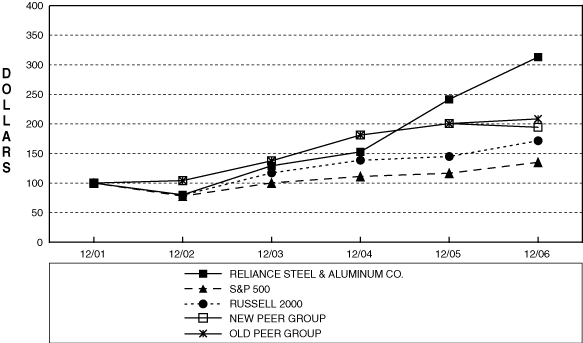
| Cumulative Total Return | ||||||||||||||||||||||||
| 12/01 | 12/02 | 12/03 | 12/04 | 12/05 | 12/06 | |||||||||||||||||||
|
Reliance Steel & Aluminum Co.
|
100 | 80.11 | 129.20 | 152.69 | 241.47 | 313.00 | ||||||||||||||||||
|
Old Peer Group
|
100 | 104.15 | 137.55 | 181.12 | 200.55 | 208.48 | ||||||||||||||||||
|
New Peer Group
|
100 | 104.15 | 137.55 | 181.12 | 200.55 | 194.31 | ||||||||||||||||||
|
S&P 500
|
100 | 77.90 | 100.24 | 111.15 | 116.61 | 135.03 | ||||||||||||||||||
|
Russell 2000
|
100 | 79.52 | 117.09 | 138.55 | 144.86 | 171.47 | ||||||||||||||||||
| * | $100 Invested on December 31, 2001 in stock or index — including reinvestment of dividends. Fiscal year ending December 31. |
31
CERTAIN
TRANSACTIONS
In 2006, there were no related party transactions with any
director or executive officer of the Company or any other
related person, as defined in Rule 404, and none is
proposed. The Board of Directors has not adopted any policies or
procedures with respect to the review of any proposed
transactions other than to require that all material facts be
disclosed to the full Board of Directors and that all
disinterested persons will then review and consider what, if any
actions need to be taken.
Each Indemnification Agreement provides that Reliance will
indemnify the indemnitee and hold him or her harmless, to the
fullest extent permitted by law, from all amounts which he or
she pays or is obligated to pay as a result of claims against
him or her arising out of his or her service to Reliance,
including derivative claims by or in the right of Reliance.
Reliance has agreed to indemnify against the amounts of all
damages, judgments, sums paid in settlement (if approved by
Reliance, which approval will not be unreasonably withheld),
counsel fees, costs of proceedings or appeals, and fines and
penalties (other than fines and penalties for which
indemnification is not permitted by applicable law) within the
scope of the indemnification.
In addition, Reliance has purchased directors and officers
liability insurance for the benefit of its directors and
officers.
SECTION 16(A)
BENEFICIAL OWNERSHIP REPORTING COMPLIANCE
Section 16(a) of the Securities Exchange Act of 1934, as
amended, requires that our officers and directors and any person
who directly or indirectly is the beneficial owner of more than
10% of our Common Stock must file reports of beneficial
ownership and any changes in such ownership. The three forms
used for reports are: the Form 3, which is an initial
statement of beneficial ownership of such securities; the
Form 4, which reports changes in beneficial ownership, and
the Form 5, which is an annual statement to report changes
that have not previously been reported. Each of these forms must
be filed at specified times.
Based solely on our review of such forms and written
representations made by certain of such reporting persons,
Reliance believes that during the year ended December 31,
2006, all persons have complied with the requirements of
Section 16(a).
INDEPENDENT
REGISTERED PUBLIC ACCOUNTING FIRM
Ernst & Young LLP has acted as our independent
auditors for more than sixty-five years. The Audit Committee and
the Board of Directors selected, and our shareholders approved,
Ernst & Young LLP to serve as the independent
registered public accounting firm for the Company to perform the
annual audit of our 2006 financial statements. We paid our
independent registered public accounting firm the amounts set
forth in the tables below for services provided in the last two
years. Audit fees are the aggregate fees for services of the
independent registered public accounting firm for audits of our
annual financial statements, the audit of management’s
assessment of internal control over financial reporting and the
independent registered public accounting firm’s own audit
of our internal control over financial reporting, including
testing and compliance with Section 404 of the
Sarbanes-Oxley Act, and review of our quarterly financial
statements included in our
Forms 10-Q,
and services that are normally provided by the independent
registered public accounting firm in connection with statutory
and regulatory filings or engagements for those fiscal years,
such as our 2006 filings related to our acquisition of EMJ and
our debt offering. This category also includes advice on
accounting matters that arose during, or as a result of, the
audit or review of interim financial statements, statutory
audits required by
non-U.S. jurisdictions
and the preparation of an annual “management letter”
on internal control matters. Audit-related fees are those fees
for services provided by the independent registered public
accounting firm that are reasonably related to the performance
of the audit or review of our financial statements and not
included as audit fees. Our audit-related fees were paid for
accounting consultations, benefit plan audits, due diligence
reviews in connection with certain potential acquisition
targets, certain of which were completed, and reviews of our
various regulatory filings. We paid tax fees for tax advice,
planning and compliance, principally in connection with the
preparation of our tax returns, and assistance related to our
election of Section 338(h)(10) treatment for certain of our
acquisitions, due diligence reviews for certain of our 2006
acquisitions, and assistance with certain governmental tax
audits.
32
|
Audit Fees
|
||||
|
2006
|
$ | 3,558,000 | ||
|
2005
|
$ | 1,923,000 | ||
|
Audit-Related Fees
|
||||
|
2006
|
$ | 109,000 | ||
|
2005
|
$ | 125,000 | ||
|
Tax Fees
|
||||
|
2006
|
$ | 1,235,000 | ||
|
2005
|
$ | 667,000 | ||
|
All Other Fees
|
||||
|
2006
|
$ | -0- | ||
|
2005
|
$ | -0- | ||
The Audit Committee approved all of these fees in advance. The
Audit Committee has adopted a Pre-Approval Policy that requires
that the Audit Committee approve in advance the engagement
letter and all audit fees set forth in such letter for the
independent registered public accounting firm. In addition, the
Audit Committee will review proposed audit, audit-related, tax
and other services that management desires the independent
registered public accounting firm to perform to ensure that such
services and the proposed fees related to the services will not
impair the independent registered public accounting firm’s
independence and that such services and fees are consistent with
the rules established by the Securities and Exchange Commission.
Each quarter the Chief Financial Officer of the Company reports
to the Audit Committee what services have been performed and
what fees incurred. The Audit Committee has delegated to the
Chairman of the Audit Committee the authority to add to, amend
or modify the list of services to be provided or the amount of
fees to be paid; provided that the Chairman will report any
action taken to the Audit Committee at its next scheduled
meeting and provided further that the fees involved are
reasonably expected to be less than $100,000.
A representative of Ernst & Young LLP will be present
at the Annual Meeting, will have an opportunity to make a
statement if he or she desires to do so, and will be available
to respond to appropriate questions. At the Annual Meeting, the
shareholders will be asked to ratify and approve this selection.
The Board of Directors recommends that shareholders
vote FOR the ratification of the selection of
Ernst & Young LLP as our independent registered public
accounting firm for 2007. Unless otherwise indicated on your
proxy, the proxyholders will vote FOR the ratification of
Ernst & Young LLP as our independent registered public
accounting firm for 2007.
OTHER
MATTERS
While management has no reason to believe that any other
business will be presented at the Annual Meeting, if any other
matters should properly come before the Annual Meeting, the
proxies will be voted as to such matters in accordance with the
best judgment of the proxy holders.
33
SHAREHOLDER
PROPOSALS FOR 2008 ANNUAL MEETING
We must receive any shareholder proposals intended to be
presented at the 2008 Annual Meeting and included in our proxy
materials relating to such meeting not later than
December 10, 2007. Such proposals must be addressed to the
Secretary of Reliance.
Reliance will furnish without charge to any shareholder, upon
written request directed to the Secretary of Reliance at its
address appearing at the top of the first page of this Proxy
Statement, a copy of its most recent Annual Report on
Form 10-K
filed with the Securities and Exchange Commission.
By Order of the Board of Directors,
Yvette M. Schiotis
Secretary
Secretary
Los Angeles, California
April 10, 2007
34
APPENDIX A
RELIANCE
STEEL & ALUMINUM CO.
AUDIT
COMMITTEE CHARTER
Organization
The Audit Committee (the “Committee”) of the Board of
Directors of Reliance Steel & Aluminum Co.
(“Reliance”) shall be composed of three or more
members of the Board of Directors (the “Board”), each
of whom is financially literate and at least one of whom has
accounting or related financial management experience that will
qualify him or her as a financial expert as defined by the New
York Stock Exchange (“NYSE”) and the Securities and
Exchange Commission (“SEC”). All members of the
Committee shall be free of any relationship that may interfere
with their exercise of independent judgment and shall meet the
requirements for independence and for committee membership
established by the NYSE and the SEC. The members of the
Committee shall be appointed by the Board and shall serve at the
pleasure of the Board and for such term or terms as the Board
may determine. The Board shall designate one member of the
Committee as its chairperson.
Purpose
The primary purpose of the Committee is to assist the Board in
fulfilling the Board’s oversight responsibilities over
Reliance’s financial reporting process and systems of
internal controls, monitoring the independence, qualifications
and performance of Reliance’s independent registered public
accountant, pre-approving all fees paid to the independent
registered public accountant and maintaining open communication
between the Board and the independent registered public
accountant, the internal auditors and financial management.
Without limiting the foregoing, the Committee shall also assist
the Board in fulfilling its oversight responsibilities of
(1) the integrity of Reliance’s financial statements,
(2) Reliance’s compliance with legal and regulatory
requirements insofar as they pertain to the audit function and
the integrity of Reliance’s financial statements, and
(3) the performance of Reliance’s internal audit
function.
Responsibilities
Review
Procedures
1. Annually review the Charter and the Committee’s
adherence to it.
2. Annually review with Reliance’s counsel legal
matters that could have a significant impact on the financial
statements.
3. Review with financial management and the independent
registered public accountant Reliance’s annual and
quarterly financial statements prior to filing or distribution,
as well as any earnings press releases, and review with
management any earnings guidance.
4. Review and discuss with management and the independent
registered public accountant (a) Reliance’s accounting
policies and principles, (b) any significant changes to
Reliance’s accounting policies and principles, and
(c) any items required to be communicated by the
independent registered public accountant in accordance with the
American Institute of Certified Public Accountants Statement on
Auditing Standards No. 61 (“AICPA SAS 61”).
5. Discuss with management, the internal auditors and the
independent registered public accountant any significant
financial risks and the policies or actions required to minimize
such risks.
6. Annually review related party transactions for potential
conflicts of interest.
7. Review financial and accounting personnel succession
planning.
Independent
Registered Public Accountant
1. Annually appoint, retain and oversee the work of the
independent registered public accountant after evaluating
independence, performance and cost effectiveness. The Committee
must approve any discharge of the
A-1
independent registered public accountant. The Committee shall
resolve any disagreements between management and the independent
registered public accountant regarding financial reporting
matters. The independent registered public accountant is
ultimately accountable to the Committee and the Board and must
report to the Committee.
2. Annually obtain and review a written report from
independent registered public accountant disclosing (a) the
auditor’s internal quality-control procedures, (b) any
material issues raised by the most recent internal
quality-control review or peer review of the independent
registered public accountant, (c) any review of the
independent registered public accountant or any material issues
raised by any inquiry or investigation of the independent
registered public accountant by governmental or professional
authorities, within the preceding five years, respecting one or
more independent audits carried out by the auditor, including,
but not limited to, the Public Company Accounting Oversight
Board (“PCAOB”) (d) any steps taken to deal with
any such issues, (e) the independent registered public
accountant’s registration with PCAOB and (f) all
relationships between the independent registered public
accountant and Reliance, with particular focus on the potential
impact which such relationships may have on the auditor’s
independence and objectivity. Review any non-audit services
provided by the independent registered public accountant to
Reliance and determine the compatibility of such services with
the independent registered public accountant’s independence
and objectivity.
3. Pre-approve all audit and non-audit engagement terms and
fees and other amounts to be paid to the independent registered
public accountant (other than amounts to be paid for non-audit
services which fall within the de minimus exception of the
Sarbanes Oxley Act of 2002).
4. Review the experience and qualifications of the senior
members of the independent registered public accountant and
their quality control procedures.
5. Review with the independent registered public accountant
(a) the scope and procedures of the audit, (b) the
results of the audit in accordance with AICPA SAS 61, as
amended, (c) the auditor’s findings and
recommendations, (d) the opinions to be issued in respect
to Reliance’s financial statements and internal control
over financial reporting prior to any filings or other
distribution and (e) the quality and acceptability of
Reliance’s accounting principles, including any audit
problems or difficulties and management’s response.
6. Review with the independent registered public
accountant, Reliance’s internal auditors and financial
management, the integrity, adequacy and effectiveness of the
accounting and other financial controls of Reliance.
7. Provide an opportunity for direct communication between
the Board and the internal auditors and independent registered
public accountant, including the opportunity to meet with the
Committee without members of management present.
8. Review with management and the independent registered
public accountant the financial information, including
management’s discussion and analysis, to determine that the
independent registered public accountant is satisfied with the
disclosure and content of the financial information.
9. Establish policies regarding Reliance’s hiring of
employees or former employees of the independent registered
public accountant.
Internal
Audit Department
1. Review with Reliance’s internal auditors the
independence and authority of their reporting obligations and
proposed audit plans and their coordination with the independent
registered public accountant, as well as any significant
findings or reports prepared by the internal auditors and
management’s response and
follow-up.
The internal auditors shall be responsible to senior management,
but shall report to the Board through the Committee.
2. Review the experience and qualifications of the senior
members of the internal auditors.
3. Review the performance of Reliance internal auditors.
The Committee must approve management’s appointment,
termination or replacement of the internal auditors.
4. Review and discuss with management and the independent
registered public accountant the adequacy of Reliance’s
internal controls and internal auditing procedures.
A-2
Other
Responsibilities
1. Establish procedures for the receipt, retention and
treatment of complaints received regarding accounting, internal
accounting controls or auditing matters and the confidential,
anonymous submission by employees of concerns regarding
questionable accounting or auditing matters. Consider, and, if
appropriate, investigate any matter brought to the attention of
the Committee within the scope of its duties. The Committee
shall have direct access to the independent registered public
accountant and Reliance personnel and may retain, at
Reliance’s expense, special legal, accounting or other
consultants or experts.
2. Annually prepare a report to shareholders as required by
the Securities and Exchange Commission.
3. Annually perform an evaluation of the Committee and
assess the effectiveness of management’s
“tone-at-the-top.”
4. Engage independent counsel and other advisers as the
Committee determines necessary to carry out its duties.
While the Committee has the responsibilities and powers set
forth in this Charter, the Committee is not responsible for
planning or conducting audits or determining that Reliance
financial statements are complete and accurate and prepared in
accordance with generally accepted accounting principles. Those
duties are the responsibility of management and the independent
registered public accountant. Nor is it the duty of the
Committee to conduct investigations or to assure compliance with
Reliance’s Code of Conduct or other policies.
Compensation
and Independence
Other than in their capacity as Board members or Board committee
members, the members of the Committee shall not accept any
consulting, advisory or other compensatory fee from Reliance and
they shall not be an affiliated person of Reliance or its
subsidiaries.
Meetings
The Committee shall meet at least four times each year and at
such other times as it may deem appropriate to carry out its
responsibilities and may, in its sole discretion, form and
delegate authority to subcommittees (comprised only of Audit
Committee members) in furtherance of such responsibilities. The
Committee shall maintain minutes of its meetings and shall
report its activities to the Board on a regular basis.
A-3